Trying to improve male fertility can quickly become confusing.
Search online and you’ll find dozens of supplements promising better sperm count, stronger motility, healthier testosterone levels, improved semen quality, and even a better chance of conception.
Fertility Factor 5 takes a relatively simple approach.
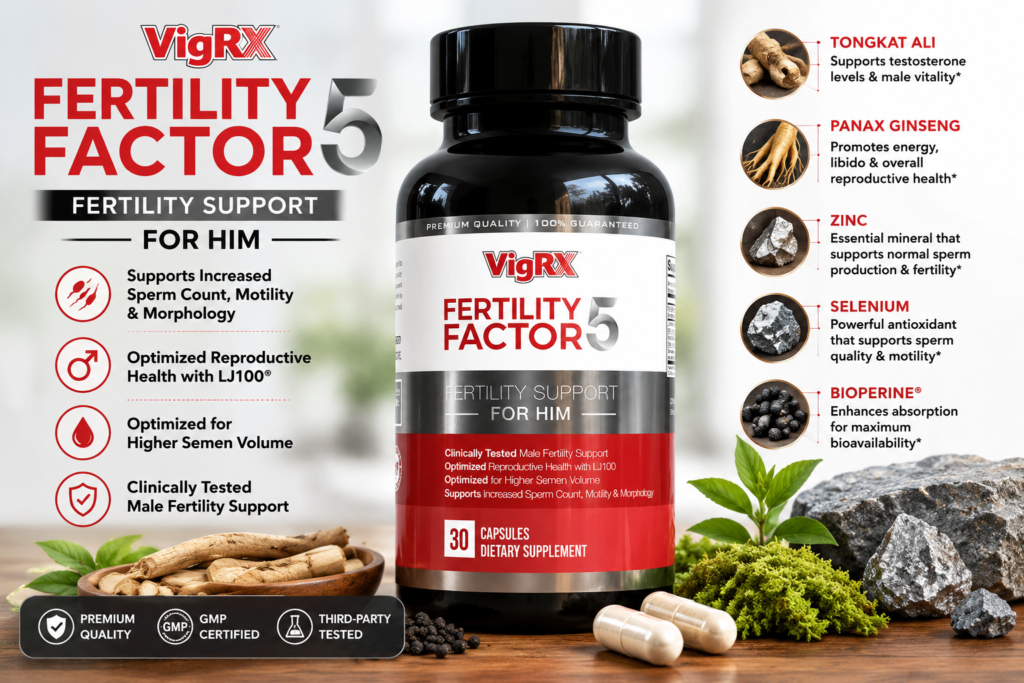
Instead of packing dozens of ingredients into its formula, it focuses on five primary components associated with male reproductive health: Tongkat Ali, Panax ginseng, zinc, selenium, and BioPerine®.
That sounds promising—but a good ingredient list isn’t enough to prove that a fertility supplement works.
So, in this Fertility Factor 5 review, we’re taking a closer look at the formula, scientific evidence, potential benefits, limitations, safety considerations, and how it compares with other male fertility supplements.
Most importantly, we’ll separate what the research actually shows from what supplement marketing may lead you to believe.
Quick verdict: Fertility Factor 5 contains several scientifically interesting ingredients, particularly its standardized Tongkat Ali extract, zinc, and selenium. However, evidence supporting individual ingredients should not be confused with proof that the finished supplement can treat male infertility or increase pregnancy rates.
Fertility Factor 5 Review: Quick Overview
| Category | Details |
|---|---|
| Product | Fertility Factor 5 |
| Category | Male fertility dietary supplement |
| Primary purpose | Male reproductive and sperm-health support |
| Key botanical | Standardized Tongkat Ali extract |
| Other notable ingredients | Panax ginseng, zinc, selenium, BioPerine® |
| Designed for | Adult men interested in reproductive health |
| Major areas targeted | Sperm health, motility, concentration, sexual health |
| Prescription required? | No |
| Our assessment | Promising ingredient rationale, but limited evidence for the finished product itself |
Our Rating
Formula: 8/10
Ingredient research: 8/10
Product-specific clinical evidence: 5/10
Formula simplicity: 9/10
Overall: 7.5/10
The score reflects our assessment of the formulation and available evidence—not a guarantee that the supplement will improve fertility.

What Is Fertility Factor 5?
Fertility Factor 5 is a dietary supplement designed for men interested in supporting reproductive health.
Unlike a standard multivitamin, the formula is targeted specifically toward areas commonly associated with male fertility, including:
- sperm concentration;
- sperm motility;
- sperm morphology;
- semen quality;
- male reproductive function;
- libido and sexual health.
Its most notable ingredient is a standardized form of Tongkat Ali (Eurycoma longifolia).
The formula also includes Panax ginseng, zinc, selenium, and BioPerine.
What makes the product interesting isn’t simply that these ingredients sound exotic. Several of them have actually been investigated scientifically in connection with male reproductive health.
But there is a crucial distinction:
Research on an ingredient is not automatically research on the finished supplement.
We will return to this distinction throughout our review.
Who Makes Fertility Factor 5?
Before purchasing any supplement, we recommend looking beyond the front of the bottle.
Consumers should check:
- who manufactures or distributes the product;
- where it is manufactured;
- the current Supplement Facts panel;
- exact ingredient dosages;
- allergen information;
- refund conditions;
- shipping policies;
- customer-service contact information.
Supplement formulas and commercial terms can change, so we recommend verifying the current information on the manufacturer’s official website rather than relying entirely on older third-party reviews.
Fertility Factor 5 Ingredients
The formula is built around five principal components:
- Tongkat Ali
- Panax ginseng
- Zinc
- Selenium
- BioPerine®
Let’s examine each one separately.
1. Tongkat Ali
Tongkat Ali, scientifically known as Eurycoma longifolia, is a plant native to Southeast Asia.
It has a long history of traditional use and has attracted modern scientific interest for potential effects involving:
- male reproductive function;
- testosterone;
- libido;
- sexual health;
- sperm parameters.
Fertility Factor 5’s use of a standardized Tongkat Ali extract is arguably the most compelling aspect of the formula.
What Does the Research Say?
Some human research involving standardized Eurycoma longifolia extracts has investigated semen parameters in men experiencing fertility problems.
Reported areas of interest have included:
- sperm concentration;
- motility;
- morphology;
- semen quality.
That’s encouraging.
But it would be inaccurate to jump from that evidence to:
“Fertility Factor 5 is clinically proven to cure male infertility.”
Those are two very different claims.
Research involving a particular standardized ingredient does not necessarily demonstrate that the finished Fertility Factor 5 formula increases pregnancy or live-birth rates.
Our Take on Tongkat Ali
Evidence rating: Promising
Tongkat Ali is one reason Fertility Factor 5 deserves consideration among male fertility supplements.
But we’d like to see more large, independent, randomized clinical trials before treating it as an established fertility intervention.
2. Zinc
Zinc may not sound as exciting as Tongkat Ali, but it is arguably one of the most biologically important ingredients in the formula.
Zinc is an essential trace element involved in male reproductive physiology.
Research has linked zinc with processes involving:
- spermatogenesis;
- sperm maturation;
- sperm motility;
- reproductive hormone function;
- fertilization.
Recent scientific reviews continue to describe zinc as important to spermatogenesis and male reproductive function.
However, there is an important nuance.
Zinc Deficiency vs. More Zinc
If inadequate zinc contributes to impaired reproductive health, correcting that deficiency may be beneficial.
That doesn’t mean:
more zinc = more fertility.
The relationship isn’t necessarily linear.
Men who already consume sufficient zinc shouldn’t assume that increasingly high supplemental doses will continuously improve sperm quality.
Our Take on Zinc
Evidence rating: Strong biological rationale
Zinc deserves a place in the conversation around male reproductive nutrition.
The potential benefit of supplementation, however, depends partly on baseline nutritional status.
3. Selenium
Selenium is another essential trace mineral relevant to reproductive biology.
It contributes to antioxidant systems and normal reproductive processes.
Research has investigated selenium in connection with:
- spermatogenesis;
- sperm motility;
- oxidative stress;
- sperm quality;
- reproductive function.
A systematic review of selenium and reproductive function concluded that selenium has an important biological role but also highlighted something consumers often overlook:
Both too little and too much can be problematic.
That’s why we don’t subscribe to the idea that higher supplemental doses are automatically better.
Our Take on Selenium
Evidence rating: Biologically relevant, but dose matters
Selenium makes sense in a male fertility formula, but supplementation should be considered in the context of total dietary and supplemental intake.
4. Panax Ginseng
Panax ginseng has been used traditionally for centuries.
Modern research has examined it for several areas of men’s health, including:
- sexual function;
- fatigue;
- reproductive function;
- libido;
- erectile function.
Its inclusion makes sense as a supporting botanical ingredient.
But once again, research on ginseng shouldn’t be presented as direct proof that Fertility Factor 5 increases fertility.
Our Take on Panax Ginseng
Evidence rating: Interesting but developing
It’s a useful supporting component, but not the ingredient on which we’d base our entire purchasing decision.
5. BioPerine®
BioPerine is a standardized black pepper extract containing piperine.
You’ll see it in many dietary supplements.
Its primary role is generally not to improve male fertility directly.
Instead, piperine is commonly included in formulations to influence the bioavailability of certain compounds.
Our Take on BioPerine
Evidence rating: Supporting ingredient
Think of BioPerine as part of the formulation strategy rather than the main reason to purchase Fertility Factor 5.
Fertility Factor 5 Ingredient Evidence Table
| Ingredient | Why It’s Included | Evidence for Male Reproductive Health | Our Assessment |
|---|---|---|---|
| Tongkat Ali | Reproductive/sexual support | Human research exists involving male reproductive parameters | Promising |
| Zinc | Essential reproductive nutrient | Strong physiological rationale and extensive research | Good |
| Selenium | Reproductive and antioxidant function | Research supports biological importance, but optimal intake matters | Good |
| Panax Ginseng | Male vitality and sexual/reproductive support | Some supportive research | Moderate |
| BioPerine | Bioavailability support | Primarily supports formulation/absorption | Supporting ingredient |
The important takeaway is that Fertility Factor 5 doesn’t rely entirely on obscure herbal ingredients.
There is legitimate scientific interest behind several components.
The remaining question is whether those components translate into meaningful fertility outcomes when combined in this particular supplement.
Visit Fertility Factor 5 Official Website
How Does Fertility Factor 5 Work?
Fertility Factor 5 appears to approach male reproductive health through several complementary pathways.
1. Nutritional Support
Zinc and selenium are essential micronutrients involved in normal physiological processes relevant to reproduction.
2. Botanical Support
Tongkat Ali and Panax ginseng provide the botanical side of the formula.
3. Oxidative-Stress Support
Oxidative stress has been investigated extensively in relation to sperm health.
Sperm cells can be particularly vulnerable to oxidative damage, which helps explain why antioxidants and antioxidant-related nutrients appear so frequently in male fertility supplements.
4. Sexual-Health Support
Some ingredients have also been investigated in relation to libido and sexual function.
That’s relevant because fertility isn’t determined solely by sperm laboratory measurements.
5. Bioavailability
BioPerine is included primarily as a formulation-support ingredient.
Put together, this creates a biologically plausible male reproductive-health formula.
But biological plausibility is not the same thing as demonstrated clinical effectiveness.
Does Fertility Factor 5 Really Work?
This is the question most readers probably came here to answer.
The most scientifically responsible answer is:
Fertility Factor 5 contains ingredients with evidence relevant to male reproductive health, but that doesn’t guarantee that the complete supplement will improve fertility for every man.
There are several reasons.
Male infertility can have many different causes.
These may include:
- hormonal abnormalities;
- varicocele;
- genetic conditions;
- obstruction;
- infections;
- certain medications;
- environmental exposures;
- smoking;
- excessive alcohol intake;
- obesity;
- heat exposure;
- sexual dysfunction;
- impaired sperm production;
- idiopathic or unexplained infertility.
A nutritional supplement cannot reasonably be expected to correct every possible cause.
For example, taking additional zinc won’t remove an anatomical obstruction.
Tongkat Ali won’t correct every genetic cause of impaired sperm production.
That’s why determining why fertility is impaired can be more important than simply choosing a supplement.
What Does Scientific Research Say About Male Fertility Supplements?
This is where we think consumers deserve more transparency.
There’s a difference between:
“This ingredient participates in sperm biology.”
and:
“Taking this supplement has been proven to help couples have babies.”
The second statement requires a much higher level of evidence.
Zinc Research
Zinc has an established role in normal male reproductive physiology.
Scientific reviews have discussed its involvement in spermatogenesis, sperm maturation, motility and fertilization.
More recent reviews have also reported associations between abnormal zinc levels and poorer semen parameters.
The evidence therefore gives zinc a strong biological rationale.
But research doesn’t justify assuming that every man trying to conceive should simply consume more zinc.
Deficiency status matters.
Selenium Research
Selenium has also been extensively studied.
A systematic review published in the Journal of Endocrinological Investigation concluded that selenium plays important roles in gonadal development, gametogenesis and fertilization.
But researchers also described a bell-shaped relationship: inadequate levels can be problematic, while excessive levels may also produce undesirable effects.
More recent research continues to investigate selenium and sperm quality, while emphasizing the need to determine optimal status and supplementation doses.
What Do Male Infertility Guidelines Say About Supplements?
This may be the single most important section of this review.
The American Urological Association and American Society for Reproductive Medicine have published evidence-based guidance on male infertility.
Their position on supplements is cautious.
The guideline notes that the clinical utility of supplements such as antioxidants and vitamins in treating male infertility is questionable and that available data aren’t sufficient to recommend specific agents.
That doesn’t mean:
“All fertility supplements are useless.”
It means:
the evidence isn’t strong enough to treat supplements as established infertility therapy.
That’s a much more accurate interpretation.
This is why we classify Fertility Factor 5 as a dietary supplement for reproductive-health support, not a treatment or cure for infertility.
Ingredient Evidence vs. Finished-Product Evidence
This distinction is frequently blurred in supplement marketing.
Imagine Ingredient A has been shown in a clinical trial to improve a particular semen parameter.
A company puts Ingredient A into Product B.
It would then be tempting to say:
Product B is clinically proven to improve that semen parameter.
But that’s not necessarily true.
The finished formula may contain:
- a different dose;
- a different extract;
- additional ingredients;
- different administration instructions;
- different bioavailability characteristics.
More importantly, the complete formula itself may never have undergone an equivalent randomized trial.
We therefore evaluate Fertility Factor 5 on two levels:
Ingredient-Level Evidence
Reasonably interesting.
Several ingredients have legitimate scientific relevance.
Finished-Product Evidence
More limited.
We haven’t found sufficient high-quality independent evidence to describe the complete supplement as a proven treatment for infertility.
This distinction significantly affects our overall rating.
Can Fertility Factor 5 Increase Sperm Count?
It may support factors associated with sperm production, particularly in certain men, but an increase shouldn’t be guaranteed.
Sperm concentration can be influenced by:
- nutritional status;
- hormones;
- genetics;
- testicular function;
- lifestyle;
- medications;
- illness;
- environmental factors.
If low sperm concentration has a correctable nutritional component, supplementation may make more biological sense.
If the underlying problem is something entirely different, the response may be limited.
Can Fertility Factor 5 Improve Sperm Motility?
There is research interest around several of its ingredients and sperm motility.
Zinc and selenium are relevant to sperm biology, while standardized Tongkat Ali extracts have also been investigated for semen parameters.
That makes improved motility a plausible area of interest.
But it isn’t a guaranteed outcome.
Can Fertility Factor 5 Improve Sperm Morphology?
Possibly, depending on the underlying issue.
Some ingredient-level research has examined sperm morphology, but consumers should be careful about translating changes in individual semen parameters into guaranteed conception outcomes.
Semen analysis is useful, but fertility is more complicated than a single number.
Can Fertility Factor 5 Increase Semen Volume?
Semen volume and sperm count aren’t the same thing.
That’s an important distinction.
A man can have a relatively large ejaculate without necessarily having a high sperm concentration.
Likewise, increasing semen volume doesn’t automatically improve fertility.
If semen volume is your primary objective rather than conception, you may want to compare products designed more specifically around ejaculate volume.
Fertility Factor 5 vs. Other Male Fertility Supplements
Fertility Factor 5 isn’t your only option.
We compared it with several other products in our comprehensive guide:
[5 Best Male Fertility Supplements to Increase Sperm Count, Motility and Ejaculate Volume in 2026]
Our roundup compares:
- Fertility Factor 5;
- Semenoll;
- Semenax;
- Beli Men;
- Prenatal for Him.
If you’re still deciding which formula fits your goals, we recommend reading that comparison before purchasing.
Fertility Factor 5 vs. Semenoll
The biggest difference is formulation strategy.
Fertility Factor 5 uses a relatively compact formula built around five primary components.
Semenoll uses a broader combination of amino acids, minerals and botanical extracts.
Neither should be considered a guaranteed infertility treatment.
If you prefer a smaller, more targeted formula with standardized Tongkat Ali, Fertility Factor 5 may be more appealing.
If you want a broader formula, Semenoll may deserve comparison.
Fertility Factor 5 vs. Semenax
These products shouldn’t necessarily be viewed as interchangeable.
Fertility Factor 5 is positioned more specifically toward reproductive support.
Semenax places considerably more emphasis on semen volume and sexual experience.
Men primarily interested in conception should therefore evaluate the two products differently from someone primarily interested in ejaculate volume.
Fertility Factor 5 for Men Over 40
Age deserves special attention.
Male fertility doesn’t suddenly disappear at 40, but reproductive parameters can change with age.
Men over 40 shouldn’t automatically assume that taking a fertility supplement will compensate for every age-related reproductive change.
The more useful approach is to consider:
- overall health;
- medications;
- testosterone and other hormones when clinically appropriate;
- semen analysis;
- lifestyle;
- partner factors;
- underlying reproductive conditions.
A supplement can potentially be part of that picture, but shouldn’t replace the bigger picture.
How Long Does It Take to Improve Sperm Quality?
Don’t judge a fertility supplement after three days.
Sperm production and maturation take time.
This is one reason claims such as:
“Boost sperm count overnight”
should immediately make you skeptical.
Changes in libido or energy can potentially occur much faster than measurable changes in semen parameters.
And feeling different isn’t proof that sperm concentration or motility has improved.
If you’re genuinely evaluating fertility, objective testing such as semen analysis is much more useful than subjective impressions.
How to Take Fertility Factor 5
Follow the current instructions printed on the product label or provided by the manufacturer.
We intentionally don’t recommend modifying the manufacturer’s dose ourselves.
Don’t assume that doubling the dose will produce faster results.
With nutrients such as zinc and selenium in particular, unnecessarily increasing total intake isn’t automatically beneficial.
Remember to account for supplements you already use.
For example, your:
- multivitamin;
- fertility supplement;
- mineral supplement;
- sports supplement;
may contain overlapping ingredients.
Always consider total intake, not just what’s present in one bottle.
Fertility Factor 5 Side Effects and Safety
A common mistake in supplement reviews is describing a formula as:
“100% natural, therefore completely safe.”
Natural doesn’t mean risk-free.
Herbs, minerals and dietary supplements can produce side effects or interact with medications.
Individual tolerance also differs.
Potential concerns depend on:
- dose;
- health status;
- medications;
- other supplements;
- allergies;
- individual response.
If you’re taking prescription medication or have an existing medical condition, discuss the complete ingredient list with an appropriate healthcare professional.
A Special Warning About Testosterone and Fertility
This deserves its own section because it’s counterintuitive.
A man trying to conceive might assume:
Low testosterone → take testosterone → improve fertility.
But exogenous testosterone can suppress sperm production.
Current AUA/ASRM guidance specifically states that testosterone monotherapy should not be prescribed to men interested in current or future fertility.
Therefore, don’t combine fertility goals with unsupervised hormone treatment.
If you have symptoms suggesting low testosterone while trying to conceive, speak with an appropriately qualified clinician.
Fertility Factor 5 Pros and Cons
Pros
Focused formula
Five principal ingredients make the formula easier to evaluate than supplements containing dozens of poorly explained components.
Standardized Tongkat Ali
This is probably Fertility Factor 5’s biggest differentiator.
Zinc and selenium
Both have legitimate roles in reproductive physiology.
Multiple approaches
The formula combines micronutrients with botanical ingredients rather than relying entirely on one category.
Relevant ingredient research
There is genuine scientific literature concerning several components.
Cons
Limited finished-product evidence
The biggest weakness is the gap between evidence concerning individual ingredients and evidence demonstrating outcomes from the complete formula.
Can’t address every cause of infertility
A supplement isn’t going to correct genetic, anatomical or many hormonal causes of infertility.
Results are unpredictable
Individual response can vary substantially.
Potential ingredient overlap
Men already using multivitamins or other supplements should check total zinc, selenium and other nutrient intake.
Shouldn’t replace fertility evaluation
This is particularly important for couples who have already been trying unsuccessfully to conceive.
What We Like Most About Fertility Factor 5
Our favorite aspect isn’t a flashy marketing claim.
It’s the relatively focused formulation.
Five primary ingredients are much easier to scrutinize than a “proprietary male fertility matrix” containing 25 substances with unclear amounts.
The standardized Tongkat Ali ingredient also makes the formula more interesting than one built entirely around generic herbs.
What We Like Least
We want stronger finished-product clinical evidence.
That’s the biggest limitation.
If a manufacturer conducted a well-designed randomized, double-blind, placebo-controlled trial of the exact commercial formulation and demonstrated meaningful improvements in clinically important outcomes, we’d be able to rate the evidence much more confidently.
Until then, we think the appropriate wording is:
promising
rather than:
proven.
Who Should Consider Fertility Factor 5?
It may be worth discussing with a healthcare professional if you’re an adult man who:
- is trying to conceive;
- wants nutritional support for reproductive health;
- understands the limitations of supplement research;
- prefers a relatively focused formula;
- is particularly interested in standardized Tongkat Ali;
- isn’t using supplementation as a substitute for medical care.
Who Should Probably Seek Medical Evaluation First?
Consider professional fertility evaluation rather than relying solely on supplements if you have:
- persistently abnormal semen-analysis results;
- testicular pain or swelling;
- known reproductive conditions;
- history of testicular injury;
- hormonal abnormalities;
- sexual dysfunction affecting conception;
- previous reproductive surgery;
- suspected varicocele;
- prolonged difficulty conceiving.
Fertility involves both partners, so evaluation often needs to consider the couple rather than assuming one person is responsible.
Fertility Factor 5 vs. a Multivitamin
A standard multivitamin provides broad nutritional coverage.
Fertility Factor 5 is much more targeted.
The major distinction is the inclusion of botanical ingredients such as Tongkat Ali and Panax ginseng alongside reproductive-health micronutrients.
Someone with an isolated nutritional deficiency may not necessarily require a specialized fertility formula.
Conversely, someone specifically interested in standardized Tongkat Ali wouldn’t ordinarily get that from a basic multivitamin.
Fertility Factor 5 vs. Tongkat Ali Alone
This is a legitimate question.
If Tongkat Ali is arguably the star ingredient, why not purchase it separately?
There are several considerations.
Tongkat Ali supplements can differ according to:
- extraction process;
- standardization;
- purity;
- dose;
- plant material;
- manufacturing quality.
Fertility Factor 5 also provides supporting ingredients rather than Tongkat Ali alone.
However, we haven’t seen enough comparative clinical evidence to claim that Fertility Factor 5 is necessarily superior to an appropriately selected standardized Tongkat Ali supplement.
Can Lifestyle Changes Improve Male Fertility?
Supplements shouldn’t distract from basic health.
Depending on the individual, reproductive health can be influenced by factors such as:
- smoking;
- excessive alcohol consumption;
- obesity;
- poor diet;
- physical inactivity;
- excessive heat exposure;
- certain medications;
- recreational drugs;
- underlying medical conditions.
A capsule can’t compensate for every lifestyle or medical issue.
Think of supplements as potentially supplemental, rather than foundational.
Is Fertility Factor 5 a Scam?
We wouldn’t label a supplement a scam merely because evidence for the finished formula is limited.
The more useful question is:
Does the evidence justify the claims being made?
Fertility Factor 5 contains recognizable ingredients with legitimate scientific relevance.
That’s a positive.
But consumers should distinguish between:
Ingredient has been studied
and:
Finished supplement has been proven to improve fertility
and:
Finished supplement has been proven to increase pregnancy/live-birth rates.
Those statements require different levels of evidence.
Is Fertility Factor 5 Worth Buying?
It depends on your expectations.
Fertility Factor 5 may be worth considering if:
- you want reproductive nutritional support;
- you specifically want a formula containing standardized Tongkat Ali;
- you understand that results aren’t guaranteed;
- you’ve checked the current formula and dose;
- you’ve considered interactions with medications and other supplements.
We wouldn’t recommend relying on it if:
- you’re treating it as a cure for infertility;
- you’re delaying appropriate fertility evaluation;
- you’re expecting guaranteed pregnancy;
- you’re taking multiple overlapping supplements without checking total doses;
- you have an underlying reproductive condition requiring medical treatment.
Our Final Fertility Factor 5 Verdict
After reviewing the formula and available scientific literature, we think Fertility Factor 5 is an interesting male reproductive-health supplement—but the evidence needs to be interpreted carefully.
There are several things we like.
Tongkat Ali has attracted legitimate scientific interest.
Zinc is undeniably important to male reproductive physiology.
Selenium also has an established biological role.
Panax ginseng provides another potentially relevant botanical.
And the relatively compact formula makes the product easier to evaluate.
But the most important limitation remains:
Evidence supporting the ingredients doesn’t automatically prove that Fertility Factor 5 itself improves fertility or increases the chance of pregnancy.
That’s why our overall rating is 7.5/10 rather than treating the product as a miracle fertility solution.
For an otherwise healthy adult man who understands those limitations, Fertility Factor 5 may be worth considering as part of a broader approach to reproductive health.
For someone experiencing persistent fertility problems, however, the more important next step may be identifying the underlying cause.
Frequently Asked Questions About Fertility Factor 5
What is Fertility Factor 5?
Fertility Factor 5 is a dietary supplement marketed toward men interested in supporting reproductive and sperm health.
What are the main Fertility Factor 5 ingredients?
The formula centers on Tongkat Ali, Panax ginseng, zinc, selenium and BioPerine.
Does Fertility Factor 5 really work?
Several ingredients have research relevant to male reproductive health, but that doesn’t establish that the finished supplement will improve fertility for every user.
Is Fertility Factor 5 clinically proven?
Be careful with this terminology. Research exists on ingredients used in the formula, but ingredient research isn’t automatically equivalent to clinical validation of the complete Fertility Factor 5 product.
Can Fertility Factor 5 increase sperm count?
Some of its ingredients have been investigated in relation to semen parameters, but individual results vary and increased sperm count shouldn’t be guaranteed.
Can it improve sperm motility?
There is a scientific rationale for several ingredients in relation to sperm health and motility, but more product-specific evidence would be needed to make a strong efficacy claim.
Can Fertility Factor 5 improve sperm morphology?
Some ingredient research is relevant to morphology and other semen parameters, but outcomes depend on the individual and the underlying cause of fertility problems.
Does Fertility Factor 5 increase testosterone?
Tongkat Ali has been investigated in relation to testosterone and male health, but consumers shouldn’t assume Fertility Factor 5 will produce a particular testosterone increase.
Is Fertility Factor 5 safe?
Safety depends on the current formulation, dose, individual health status, medications and other supplements being taken. Natural ingredients aren’t automatically risk-free.
How long does Fertility Factor 5 take to work?
Don’t evaluate a fertility product based on a few days of use. Sperm production and maturation take time, and objective semen testing is more meaningful than relying on subjective changes.
Can Fertility Factor 5 help men over 40?
It may provide nutritional/reproductive support, but age-related fertility changes are complex. Men over 40 shouldn’t assume supplementation alone can correct every cause of impaired fertility.
Is Fertility Factor 5 better than Semenoll?
They use different formulations. Fertility Factor 5 has a smaller, Tongkat Ali-centered formula, while Semenoll uses a broader ingredient combination. See our Best Male Fertility Supplements comparison for a more detailed breakdown.
Is Fertility Factor 5 better than Semenax?
They target somewhat different consumer goals. Fertility Factor 5 is positioned more toward reproductive support, whereas Semenax places greater emphasis on semen volume and sexual experience.
Can I take Fertility Factor 5 with a multivitamin?
Potentially, but check for overlapping ingredients—particularly zinc and selenium—and discuss supplementation with an appropriate healthcare professional when necessary.
Can testosterone improve fertility?
Testosterone treatment can actually suppress sperm production. Men interested in current or future fertility should not start testosterone monotherapy without appropriate medical guidance.
Does improving sperm count guarantee pregnancy?
No. Pregnancy depends on numerous male and female factors. Sperm concentration is only one part of fertility.
Scientific Sources & References
- AUA/ASRM — Diagnosis and Treatment of Infertility in Men: Guideline Part II
- NCBI — Zinc Is an Essential Element for Male Fertility: A Review of Zn Roles in Men’s Health, Sperm Quality, and Fertilization
- PubMed — A Systematic Review and Evidence-Based Analysis of Ingredients in Popular Male Fertility Supplements
- PubMed — A Comprehensive Review on the Potential Role of Selenium and Selenoproteins in Male Fertility
- NCBI — Ginseng and Male Reproductive Function
- NCBI — The Role of Red Ginseng in Men’s Reproductive Health: A Literature Review
- NCBI — Zinc Levels in Seminal Plasma and Their Correlation With Male Infertility: A Systematic Review and Meta-Analysis
- American Society for Reproductive Medicine — Diagnosis and Treatment of Infertility in Men: Guideline Part I
- NCBI Bookshelf — Treatment of Infertility Due to Male Factors
Related Articles on Fitness Donkey
Editorial Methodology
Fitness Donkey evaluates supplements by examining:
- ingredient identity;
- ingredient dosage when available;
- peer-reviewed research;
- evidence involving the specific ingredient or extract;
- finished-product research when available;
- safety and potential limitations;
- value compared with competing products;
- manufacturer transparency;
- relevance of the formulation to its intended purpose.
We distinguish between ingredient-level research and finished-product clinical evidence.
A study involving one ingredient isn’t automatically treated as proof that a commercial supplement containing that ingredient will produce the same clinical outcome.
Affiliate Disclosure
Fitness Donkey may receive compensation when readers purchase products through links on this page. This doesn’t change the evidence standards used in our reviews.
We encourage readers to compare products, examine current labels, review scientific evidence and seek appropriate professional advice rather than purchasing solely because of an affiliate recommendation.
Medical Disclaimer
This article is provided for informational and educational purposes and isn’t intended to diagnose, treat, cure or prevent disease.
Male infertility can have medical, hormonal, genetic, anatomical and lifestyle causes. Anyone concerned about fertility should consider discussing those concerns with an appropriately qualified healthcare professional.
Product formulations, prices, guarantees and availability can change. Verify current product information before purchasing.