Coenzyme Q10, better known as CoQ10, has become one of the most researched ingredients in male fertility supplements.
Unlike many fertility ingredients promoted mainly through traditional use or marketing, CoQ10 has been evaluated in human clinical trials, systematic reviews, and meta-analyses involving men with infertility.
The reason researchers are interested in it is straightforward.
Sperm need enormous amounts of energy to move effectively, and their membranes and DNA are vulnerable to excessive oxidative stress. CoQ10 is involved in mitochondrial energy production and also functions as an antioxidant.
That gives CoQ10 a plausible role in sperm health.
But does taking a CoQ10 supplement actually increase sperm count or improve motility? And, more importantly, can it increase the chance of pregnancy?
The evidence is promising—but not as conclusive as supplement advertisements sometimes suggest.
Quick answer: Clinical research suggests CoQ10 supplementation may improve sperm motility, concentration, and some other semen parameters in certain men with infertility. However, improvements in semen analysis do not necessarily translate into higher pregnancy or live-birth rates. CoQ10 should therefore be considered a potentially useful fertility supplement rather than a proven treatment for male infertility.
What Is CoQ10?
Coenzyme Q10 is a naturally occurring compound found throughout the human body.
It is particularly concentrated in tissues with high energy requirements.
CoQ10 has two major biological roles that make it interesting for fertility:
- mitochondrial energy production;
- antioxidant activity.
Inside mitochondria—the structures responsible for producing much of a cell’s usable energy—CoQ10 participates in the electron transport chain.
This process contributes to the production of adenosine triphosphate (ATP).
ATP is essentially cellular energy.
And sperm need energy.
A lot of it.
Why Is CoQ10 Important for Sperm?
Think about what sperm are required to do.
They aren’t stationary cells.
Sperm must use their flagella—their tails—to generate movement.
That movement requires continuous energy production.
Mitochondria are concentrated in the sperm’s midpiece and help supply the energy required for motility.
CoQ10 therefore has an obvious biological connection with sperm movement.
But energy isn’t the entire story.
CoQ10 also participates in antioxidant defense.
That matters because sperm are particularly vulnerable to oxidative damage.
CoQ10 and Oxidative Stress
Reactive oxygen species are produced naturally in the body.
They aren’t inherently harmful.
In controlled amounts, reactive oxygen species participate in processes required for normal sperm function and fertilization.
Problems arise when oxidative activity becomes excessive relative to antioxidant defenses.
This is called:
oxidative stress.
Excessive oxidative stress may damage sperm:
- membranes;
- mitochondria;
- proteins;
- and DNA.
Because CoQ10 has antioxidant properties, researchers have investigated whether supplementation might help protect sperm from excessive oxidative damage.
This is one of the primary scientific rationales behind using CoQ10 for male fertility.
Does CoQ10 Increase Sperm Count?
Several clinical studies have investigated this question.
Some randomized trials involving men with idiopathic infertility have reported improvements in sperm concentration following CoQ10 supplementation.
Systematic reviews and meta-analyses have also reported potentially favorable changes in certain semen parameters.
However, results aren’t identical across every study.
Differences may involve:
- participant characteristics;
- underlying fertility problems;
- CoQ10 dose;
- duration;
- formulation;
- baseline antioxidant status;
- lifestyle;
- study quality.
So it’s too strong to say:
“CoQ10 increases sperm count.”
A more accurate conclusion is:
CoQ10 supplementation may improve sperm concentration in some men with infertility, but it isn’t guaranteed to increase sperm count in every man.
Does CoQ10 Improve Sperm Motility?
This is arguably the most interesting potential fertility benefit of CoQ10.
Sperm movement requires energy.
CoQ10 participates directly in mitochondrial energy production.
This makes motility a biologically plausible target.
Multiple clinical studies and evidence reviews have reported improvements in sperm motility following CoQ10 supplementation in certain infertile populations.
Some research has reported changes in:
- total motility;
- progressive motility;
- sperm concentration;
- antioxidant markers.
This doesn’t mean CoQ10 can fix every case of poor motility.
Low sperm motility may also result from:
- varicocele;
- genetic disorders;
- testicular dysfunction;
- smoking;
- obesity;
- excessive heat;
- infections;
- medications;
- oxidative stress;
- environmental exposures.
CoQ10 can’t reasonably be expected to correct all of these.
Does CoQ10 Improve Progressive Motility?
Progressive motility refers specifically to sperm moving effectively in a forward direction.
This differs from sperm that move but fail to make useful forward progress.
Several CoQ10 studies have included progressive motility among their measured outcomes.
Some have reported improvement after supplementation.
This is potentially meaningful because progressive movement is particularly relevant to natural conception.
But results still need to be interpreted within the complete semen analysis.
A man can have:
good motility + extremely low sperm concentration
or:
high concentration + severely impaired motility.
One number doesn’t determine fertility.
Does CoQ10 Improve Sperm Morphology?
Some clinical studies have evaluated morphology alongside concentration and motility.
Evidence for morphology appears less consistent.
CoQ10 shouldn’t therefore be considered a proven treatment for abnormal sperm morphology.
Morphology may be influenced by:
- genetics;
- testicular function;
- oxidative stress;
- smoking;
- varicocele;
- environmental exposures;
- illness;
- and other reproductive factors.
If morphology is severely abnormal or several semen parameters are affected simultaneously, professional evaluation is more useful than relying exclusively on supplements.
Does CoQ10 Improve Sperm DNA?
This is another important area of research.
Traditional semen analysis evaluates sperm:
- concentration;
- number;
- motility;
- morphology;
- vitality.
But sperm DNA integrity may provide additional information in selected fertility situations.
Oxidative stress is one potential contributor to sperm DNA fragmentation.
Because CoQ10 has antioxidant activity, researchers have investigated whether supplementation might influence oxidative stress and sperm DNA integrity.
Some research is encouraging.
However, evidence isn’t currently strong enough to promise that CoQ10 reliably repairs sperm DNA or normalizes sperm DNA fragmentation.
That’s a much stronger claim than the evidence supports.
Can CoQ10 Improve Male Fertility?
This depends on how you define “improve fertility.”
If you mean:
Can CoQ10 improve semen-analysis parameters?
Evidence suggests it may in certain men.
If you mean:
Does CoQ10 reliably increase pregnancy and live-birth rates?
The evidence is much less certain.
This distinction is extremely important.
Suppose a study finds that progressive motility increases from one percentage to another.
That’s scientifically interesting.
But couples trying to conceive ultimately care about:
- pregnancy;
- successful pregnancy;
- and healthy live birth.
These outcomes require stronger evidence.
Does CoQ10 Increase Pregnancy Rates?
Research hasn’t conclusively established that CoQ10 supplementation in men reliably increases spontaneous pregnancy rates.
Some studies and reviews suggest potentially favorable reproductive outcomes, but evidence remains limited.
Pregnancy also depends on far more than one male semen parameter.
Factors include:
- female age;
- ovarian reserve;
- ovulation;
- fallopian-tube function;
- sperm quality;
- intercourse timing;
- reproductive anatomy;
- underlying infertility diagnoses.
Therefore, even a measurable improvement in sperm motility doesn’t guarantee pregnancy.
Does CoQ10 Increase Live-Birth Rates?
This is where evidence becomes even less certain.
Live birth is one of the strongest outcomes fertility research can measure.
Unfortunately, many male supplement studies focus primarily on laboratory outcomes such as:
- sperm concentration;
- motility;
- morphology;
- antioxidant status.
Fewer studies are sufficiently large or well-designed to determine whether supplements increase live births.
Therefore:
CoQ10 may improve certain semen parameters, but evidence demonstrating a reliable increase in live-birth rates remains insufficient.
CoQ10 and Idiopathic Male Infertility
CoQ10 has been studied particularly often in men with idiopathic infertility.
Idiopathic means no clear underlying cause has been identified despite evaluation.
This group is attractive for antioxidant research because oxidative stress may contribute to some otherwise unexplained fertility problems.
Studies involving men with idiopathic oligoasthenoteratozoospermia—a combination of abnormalities affecting sperm concentration, motility, and morphology—have investigated CoQ10 with encouraging results.
But idiopathic infertility isn’t one uniform condition.
Different men may have different unidentified biological causes.
What Is Ubiquinone?
CoQ10 supplements commonly come in two forms:
ubiquinone
and
ubiquinol.
Ubiquinone is the oxidized form of CoQ10.
It’s the form used in many supplements and has also been used in clinical research.
The body can convert between ubiquinone and ubiquinol.
What Is Ubiquinol?
Ubiquinol is the reduced form of CoQ10.
It is frequently marketed as being more bioavailable than conventional ubiquinone.
Some pharmacokinetic research suggests ubiquinol may produce higher circulating CoQ10 levels under certain circumstances.
However, that doesn’t automatically mean:
ubiquinol produces better fertility outcomes.
Bioavailability and clinical effectiveness aren’t identical concepts.
A formulation can produce higher blood levels without necessarily producing greater improvements in pregnancy, sperm count, or motility.
Ubiquinol vs. CoQ10 for Male Fertility
When people ask whether ubiquinol is better than CoQ10, they’re really comparing two forms of the same coenzyme.
There isn’t currently strong enough fertility evidence to say that every man should choose ubiquinol over ubiquinone.
Consider:
- clinical evidence for the specific formulation;
- dose;
- product quality;
- price;
- tolerability.
Don’t assume the more expensive version automatically produces better sperm.
How Much CoQ10 Is Used for Male Fertility?
There is no universally established fertility-specific dose.
Clinical studies have used different amounts.
Common research doses often fall around:
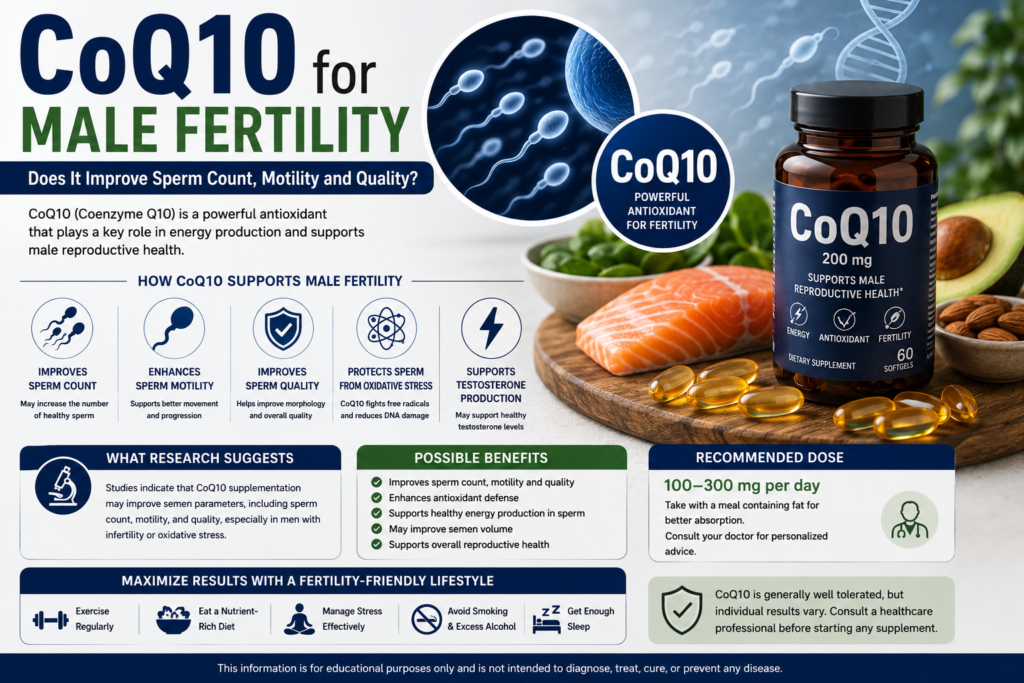
100–400 mg per day, depending on the study and formulation.
Some trials have used approximately 200 mg daily.
Others have used 300 mg or higher.
This doesn’t mean everyone trying to conceive should take those doses.
Clinical study doses aren’t automatically universal recommendations.
Is 100 mg of CoQ10 Enough for Sperm?
One hundred milligrams is a commonly available supplement dose.
However, whether it is “enough” depends on what outcome you’re trying to achieve and what evidence you’re applying.
Different fertility studies have used different dosages.
There isn’t a scientifically established threshold where:
99 mg doesn’t work
but
100 mg works.
Supplement biology isn’t that precise.
Is 200 mg of CoQ10 Good for Male Fertility?
Two hundred milligrams per day has been used in some male fertility research.
That makes it a research-relevant dose.
But it shouldn’t be interpreted as a guaranteed or universally optimal fertility dosage.
Men taking medications or managing medical conditions should discuss supplementation with an appropriate healthcare professional.
Is 300 mg of CoQ10 Better Than 200 mg?
Not necessarily.
More isn’t automatically better.
A higher dose may increase CoQ10 exposure, but that doesn’t prove it will proportionally increase:
- sperm concentration;
- motility;
- pregnancy rates.
The ideal dose-response relationship for male infertility isn’t firmly established.
How Long Does CoQ10 Take to Improve Sperm?
This is one of the most important practical questions.
Sperm production takes time.
Human spermatogenesis requires approximately 74 days, followed by additional maturation and transport through the reproductive tract.
That means meaningful changes in sperm quality generally aren’t expected overnight.
Many fertility studies therefore evaluate supplementation over periods such as:
- three months;
- six months;
- or longer.
If a product promises dramatically improved sperm within a few days, that claim doesn’t fit well with normal sperm biology.
Can CoQ10 Improve Sperm in Three Months?
Potentially.
Three months covers approximately one meaningful sperm-development cycle.
That’s why three months is frequently used as a practical timeframe for evaluating interventions affecting semen parameters.
However, improvement isn’t guaranteed.
Results depend on:
- underlying cause;
- baseline semen quality;
- health;
- lifestyle;
- age;
- dose;
- formulation;
- adherence.
If poor sperm quality results from a condition such as a major genetic abnormality or reproductive obstruction, CoQ10 isn’t going to correct the underlying problem.
Is Six Months of CoQ10 Better Than Three Months?
Some clinical trials have reported continued changes during longer supplementation periods.
But longer treatment isn’t automatically better for everyone.
If semen parameters remain substantially abnormal after several months, simply continuing supplements indefinitely may delay identification of a treatable medical cause.
Repeat semen analysis and appropriate clinical evaluation may provide more useful information.
When Should You Take CoQ10?
CoQ10 is fat-soluble.
Taking it with a meal containing some dietary fat may improve absorption.
Examples might include meals containing:
- eggs;
- fish;
- olive oil;
- avocado;
- nuts;
- dairy.
Some people also prefer taking CoQ10 earlier in the day because they feel it affects energy or alertness.
Individual tolerance varies.
Should CoQ10 Be Taken With Food?
Generally, yes.
Because CoQ10 is fat-soluble, consuming it with food—particularly a meal containing fat—can improve absorption compared with taking it under certain fasting conditions.
Product formulation also influences absorption.
Follow the directions on the specific supplement you’re using.
CoQ10 vs. Zinc for Male Fertility
These nutrients have very different roles.
CoQ10
Primarily participates in:
- mitochondrial energy production;
- antioxidant activity.
Zinc
Is an essential mineral involved in:
- spermatogenesis;
- DNA synthesis;
- reproductive function;
- sperm maturation;
- numerous enzymes.
If a man has inadequate zinc intake, correcting that deficiency is fundamentally different from taking CoQ10 as an antioxidant intervention.
Read our complete guide on zinc for male fertility for more information.
CoQ10 vs. Selenium for Male Fertility
Selenium is an essential trace mineral incorporated into selenoproteins.
These proteins participate in:
- antioxidant defenses;
- sperm structure;
- sperm development;
- thyroid metabolism.
CoQ10 also contributes to antioxidant defense but has an additional major role in mitochondrial energy production.
Because their biological functions differ, some fertility formulas contain both.
CoQ10 vs. Tongkat Ali for Male Fertility
These ingredients are even more different.
CoQ10
Has been studied primarily for:
- mitochondrial function;
- antioxidant defense;
- sperm motility;
- sperm concentration.
Tongkat Ali
Has received more attention for:
- testosterone;
- libido;
- male reproductive health;
- semen parameters;
- stress.
Neither can universally be called better.
CoQ10 arguably has a stronger research rationale specifically around sperm energy metabolism and oxidative stress, while Tongkat Ali has additional research interest involving male hormonal health.
Read our guide on Tongkat Ali for male fertility for the complete comparison.
CoQ10 vs. L-Carnitine for Sperm Motility
This is a particularly interesting comparison because both nutrients relate to energy metabolism.
L-carnitine helps transport long-chain fatty acids into mitochondria where they can be used for energy.
CoQ10 participates within the mitochondrial electron transport chain.
Both have been investigated for male infertility and sperm motility.
Some supplements combine them.
However, clinical evidence doesn’t clearly establish that one is universally superior.
Can You Take CoQ10 and L-Carnitine Together?
These ingredients have been combined in fertility supplements and research formulations.
There isn’t an inherent reason healthy adults cannot consume both at appropriate amounts.
But combining supplements doesn’t automatically create additive benefits.
The complete dose, medical history, medications, and reason for supplementation still matter.
Can You Take CoQ10 With Zinc?
Yes, these nutrients are frequently included together in fertility formulas.
They perform different biological functions.
The bigger concern with zinc is making sure your total daily intake doesn’t become excessive when combining multiple supplements.
Can You Take CoQ10 With Selenium?
Yes, they’re also frequently combined.
But selenium requires particular caution because the difference between adequate and excessive intake is relatively small compared with many nutrients.
Check all supplements for overlapping selenium.
CoQ10 and Male Fertility Supplements
CoQ10 appears in many fertility formulas because it has considerably more scientific rationale than some purely marketing-driven ingredients.
However, seeing “CoQ10” on a label doesn’t automatically make the product effective.
Ask:
- How much CoQ10 does it contain?
- Which form is used?
- Are ingredient doses disclosed?
- Does the dose resemble clinical research?
- Are other ingredients appropriately dosed?
- Has the finished product been clinically studied?
- Is manufacturing quality independently verified?
A fertility formula containing 10 mg of an ingredient shouldn’t necessarily be treated as equivalent to research using several hundred milligrams.
Dose matters.
For broader comparisons, read our best male fertility supplements article.
Why Doesn’t Every Fertility Supplement Contain CoQ10?
Formulation involves trade-offs.
CoQ10 can be more expensive than many vitamins, minerals, and inexpensive herbal powders.
Effective research doses may also require substantial capsule space.
Manufacturers may instead prioritize ingredients that:
- cost less;
- require smaller doses;
- sound attractive on a label;
- fit the product’s marketing angle.
The absence of CoQ10 doesn’t automatically make a supplement bad.
But when evaluating a product marketed specifically for sperm motility, it’s reasonable to examine why particular ingredients and doses were selected.
What Foods Contain CoQ10?
CoQ10 occurs naturally in food.
Sources include:
- organ meats;
- beef;
- chicken;
- fatty fish;
- peanuts;
- pistachios;
- certain oils;
- some vegetables.
However, food generally provides much smaller amounts than doses used in many clinical supplementation studies.
That doesn’t make food unimportant.
A nutrient-dense diet supports reproductive health through many pathways beyond CoQ10 alone.
Can You Get Enough CoQ10 From Food?
The body produces CoQ10 naturally, so it isn’t considered an essential dietary nutrient in the same way as zinc or selenium.
Diet contributes additional CoQ10.
Obtaining hundreds of milligrams through normal food intake would be difficult.
Therefore, studies testing higher CoQ10 doses generally use supplements.
But that doesn’t mean everyone requires supplementation.
Does CoQ10 Increase Testosterone?
CoQ10 isn’t primarily considered a testosterone supplement.
Some research has examined relationships between oxidative stress, mitochondrial function, aging, and hormones, but evidence doesn’t establish CoQ10 as a reliable testosterone booster for healthy men.
If testosterone is low, investigate the underlying cause rather than assuming CoQ10 will correct it.
Potential causes include:
- obesity;
- sleep disorders;
- medications;
- pituitary problems;
- testicular dysfunction;
- chronic illness;
- aging;
- and other endocrine conditions.
Does CoQ10 Increase Libido?
CoQ10 isn’t an established libido enhancer.
Improved cellular energy doesn’t automatically translate into increased sexual desire.
Libido depends on:
- hormones;
- psychological health;
- stress;
- sleep;
- medications;
- relationships;
- physical health;
- sexual function.
Don’t confuse a fertility supplement with an aphrodisiac.
Does CoQ10 Increase Semen Volume?
There isn’t strong evidence that CoQ10 reliably increases ejaculate volume.
CoQ10 research is more relevant to sperm cells themselves than to the amount of seminal fluid produced.
Semen volume is influenced by the:
- seminal vesicles;
- prostate;
- reproductive tract;
- abstinence duration;
- ejaculation frequency;
- medications;
- age;
- and other factors.
If you’re researching supplements marketed specifically for semen volume, see our SemEnhance review.
Does CoQ10 Make Semen Thicker?
There isn’t good evidence that CoQ10 supplementation predictably makes semen thicker.
More importantly, semen thickness isn’t a reliable indicator of fertility.
You cannot determine sperm count by visually examining semen.
A thick ejaculate may still contain few sperm.
A thinner-looking sample may contain a normal concentration.
Only semen analysis can quantify sperm parameters accurately.
Can CoQ10 Help With Erectile Dysfunction?
CoQ10 isn’t an established first-line treatment for erectile dysfunction.
Because cardiovascular and endothelial health influence erectile function, researchers have investigated antioxidant and mitochondrial pathways in broader cardiovascular contexts.
But persistent ED should not simply be self-treated with CoQ10.
Erectile dysfunction may be associated with:
- vascular disease;
- diabetes;
- hypertension;
- medications;
- hormonal disorders;
- neurological conditions;
- psychological factors.
Appropriate evaluation can identify the underlying problem.
Is CoQ10 Safe?
CoQ10 is generally considered well tolerated in many clinical studies.
Potential side effects can include:
- stomach discomfort;
- nausea;
- diarrhea;
- appetite changes;
- headache;
- insomnia in some individuals.
Side effects can vary depending on dose and formulation.
“Natural” doesn’t mean completely free of potential interactions or adverse effects.
Can CoQ10 Interact With Medications?
Yes.
One particularly important potential interaction involves warfarin and other situations where anticoagulation management is critical.
CoQ10 may potentially influence warfarin’s anticoagulant effect.
People taking prescription medications—especially anticoagulants—should discuss supplementation with their healthcare professional.
CoQ10 may also interact with aspects of blood-pressure or glucose management in certain individuals.
Does CoQ10 Affect Blood Pressure?
Some research has investigated CoQ10 in cardiovascular health.
It may influence blood pressure in certain populations.
If you already take blood-pressure medication, this is another reason to discuss high-dose supplementation with your healthcare provider.
Can CoQ10 Affect Sleep?
Some people report insomnia or increased alertness when taking CoQ10.
If you notice this effect, taking the supplement earlier in the day may be preferable.
However, responses vary.
Good sleep itself is important for metabolic, hormonal, and reproductive health, so continuing a supplement that consistently disrupts sleep may be counterproductive.
Who Should Be Careful With CoQ10?
Extra caution may be appropriate if you:
- take warfarin or anticoagulant medication;
- take several blood-pressure medications;
- have significant chronic disease;
- are undergoing cancer treatment;
- take multiple supplements;
- are preparing for surgery;
- or are under specialist fertility treatment.
Your healthcare provider can help determine whether supplementation is appropriate.
How to Choose a CoQ10 Supplement
Don’t judge a supplement purely by attractive packaging.
Consider:
- amount per serving;
- ubiquinone or ubiquinol form;
- manufacturer transparency;
- third-party quality testing;
- unnecessary proprietary blends;
- serving size;
- storage requirements;
- realistic claims.
Be skeptical of products promising:
- guaranteed pregnancy;
- instant sperm improvement;
- complete reversal of infertility;
- huge testosterone increases;
- or guaranteed live birth.
No CoQ10 supplement can responsibly guarantee those outcomes.
Should You Take CoQ10 When Trying to Conceive?
CoQ10 is one of the more scientifically interesting male fertility supplements.
It may be reasonable to discuss with a healthcare professional, particularly when semen parameters such as motility are abnormal.
But supplementation shouldn’t distract from fundamentals.
A comprehensive fertility strategy includes:
- avoiding smoking;
- avoiding anabolic steroids;
- discussing testosterone therapy when fertility matters;
- maintaining a healthy weight;
- exercising regularly;
- eating a nutrient-dense diet;
- sleeping adequately;
- moderating heavy alcohol consumption;
- limiting repeated excessive testicular heat;
- managing medical conditions;
- and investigating substantially abnormal semen results.
No antioxidant replaces these steps.
What If CoQ10 Doesn’t Improve Sperm Quality?
Don’t simply keep increasing the dose.
If semen parameters remain abnormal, investigate why.
Potential causes include:
- varicocele;
- hormonal disorders;
- genetic conditions;
- testicular dysfunction;
- obstruction;
- infections;
- medications;
- testosterone therapy;
- anabolic steroids;
- chemotherapy;
- radiation;
- environmental exposures.
When Should You See a Fertility Specialist?
Consider professional evaluation if:
- you’ve been trying unsuccessfully to conceive;
- sperm concentration is severely reduced;
- motility is substantially impaired;
- multiple semen parameters are abnormal;
- no sperm are detected;
- you have testicular pain or swelling;
- you’re taking testosterone;
- you’ve used anabolic steroids;
- you’ve undergone chemotherapy or radiation;
- or you have another significant reproductive concern.
A supplement shouldn’t delay diagnosis of a potentially treatable condition.
The Bottom Line
CoQ10 is one of the more promising supplements studied for male fertility.
Its scientific rationale is strong because it participates in:
- mitochondrial energy production;
- antioxidant defense;
- cellular protection.
These functions are particularly relevant to sperm because sperm require substantial energy for movement and are vulnerable to oxidative damage.
Clinical research suggests CoQ10 may improve certain semen parameters, particularly:
- sperm motility;
- progressive motility;
- sperm concentration;
- and some markers of antioxidant status.
But there is an important limitation.
Better semen-analysis numbers don’t automatically mean higher pregnancy or live-birth rates.
Current evidence doesn’t justify calling CoQ10 a cure for male infertility.
It is better viewed as a potentially useful adjunct within a broader fertility strategy.
If your semen analysis is significantly abnormal, identifying and treating the underlying cause remains more important than simply adding another supplement.
Frequently Asked Questions
Is CoQ10 good for male fertility?
Research suggests CoQ10 may support certain semen parameters in some men with infertility, particularly sperm motility and concentration. It isn’t a guaranteed fertility treatment.
Does CoQ10 increase sperm count?
Some clinical studies and meta-analyses have reported improvements in sperm concentration following CoQ10 supplementation, but results vary.
Does CoQ10 improve sperm motility?
Yes, motility is one of the semen parameters for which CoQ10 has relatively promising clinical evidence. However, it won’t necessarily correct every cause of poor motility.
Does CoQ10 improve sperm morphology?
Evidence regarding morphology is less consistent than the research involving motility and concentration.
Can CoQ10 improve sperm DNA fragmentation?
Some evidence suggests antioxidant interventions may influence oxidative damage and sperm DNA, but CoQ10 isn’t established as a guaranteed treatment for elevated DNA fragmentation.
How much CoQ10 should a man take for fertility?
There is no universally established fertility dose. Clinical studies have used various doses, commonly within approximately 100–400 mg per day.
Is 200 mg CoQ10 enough for male fertility?
Two hundred milligrams has been used in clinical research, but it isn’t established as the optimal dose for every man.
Is 300 mg CoQ10 good for sperm?
Some fertility research has used doses around this range. Higher doses aren’t automatically more effective.
Is ubiquinol better than CoQ10 for sperm?
Ubiquinol may have bioavailability advantages in certain circumstances, but evidence doesn’t establish it as universally superior for fertility outcomes.
How long does CoQ10 take to improve sperm?
Because sperm development takes approximately 74 days plus additional maturation, changes are generally evaluated over several months rather than days.
Can CoQ10 improve sperm in three months?
Potentially. Three months covers roughly one meaningful sperm-development cycle, but improvement isn’t guaranteed.
Can I take CoQ10 with zinc?
They are frequently combined in male fertility supplements. Ensure total zinc intake remains appropriate.
Can I take CoQ10 with selenium?
They can be combined, but total selenium intake needs attention because excessive selenium can be harmful.
Can I take CoQ10 with Tongkat Ali?
These ingredients act through different proposed pathways and may appear together in men’s-health regimens. More supplements don’t automatically produce better fertility outcomes.
Does CoQ10 increase testosterone?
CoQ10 isn’t established as a reliable testosterone booster.
Does CoQ10 increase semen volume?
There isn’t strong evidence that CoQ10 reliably increases ejaculate volume.
What time of day should men take CoQ10?
It can generally be taken with a meal containing some fat. People who find it stimulating may prefer taking it earlier in the day.
Related Articles on Fitness Donkey
Scientific Sources & References
- PubMed — Coenzyme Q10 and Male Infertility: A Meta-Analysis
- NCBI/PMC — Coenzyme Q10 and Male Infertility: A Systematic Review
- PubMed — Coenzyme Q10 Supplementation in Infertile Men With Idiopathic Asthenozoospermia
- NCBI/PMC — Coenzyme Q10 Supplementation in Male Infertility: A Meta-Analysis
- American Urological Association — Diagnosis and Treatment of Infertility in Men: AUA/ASRM Guideline
- World Health Organization — WHO Laboratory Manual for the Examination and Processing of Human Semen, 6th Edition
- Cochrane — Antioxidants for Male Subfertility
- NIH/NCCIH — Coenzyme Q10
Medical Disclaimer
This article is for informational and educational purposes only and isn’t intended to diagnose, treat, cure, or prevent infertility or another medical condition.
CoQ10 supplements can differ in dose, formulation, purity, and bioavailability. CoQ10 can also interact with certain medications. If you have significantly abnormal semen-analysis results, take prescription medications, or have persistent difficulty conceiving, consider discussing supplementation and fertility evaluation with an appropriately qualified healthcare professional.