Selenium frequently appears on the ingredient labels of male fertility supplements.
It’s often combined with zinc, CoQ10, L-carnitine, vitamin E, folate, or herbal ingredients and marketed for sperm count, motility, testosterone, and overall reproductive health.
There’s a legitimate biological reason for the interest.
Selenium is an essential trace mineral involved in antioxidant defense, thyroid hormone metabolism, DNA synthesis, and reproduction. Several selenium-containing proteins also play important roles in sperm development and function.
But that doesn’t mean taking large amounts of selenium automatically produces healthier sperm.
Both too little and too much selenium can be problematic.
So, where does the evidence actually stand?
This guide examines selenium’s role in male fertility, sperm count, motility, morphology, testosterone, food sources, supplementation, dosage, safety, and what current research tells us about using selenium when trying to conceive.
Quick answer: Selenium is essential for normal male reproductive function and plays important roles in sperm development and antioxidant defense. Some studies suggest selenium supplementation—particularly when combined with other antioxidants—may improve certain semen parameters in selected men. However, evidence isn’t strong enough to say selenium supplements reliably increase fertility or pregnancy rates in every man. Excessive selenium can also be toxic.
If you’re trying to improve several aspects of semen quality rather than focusing on one nutrient, read our guides on how to increase sperm count naturally and how to improve sperm motility naturally.
What Is Selenium?
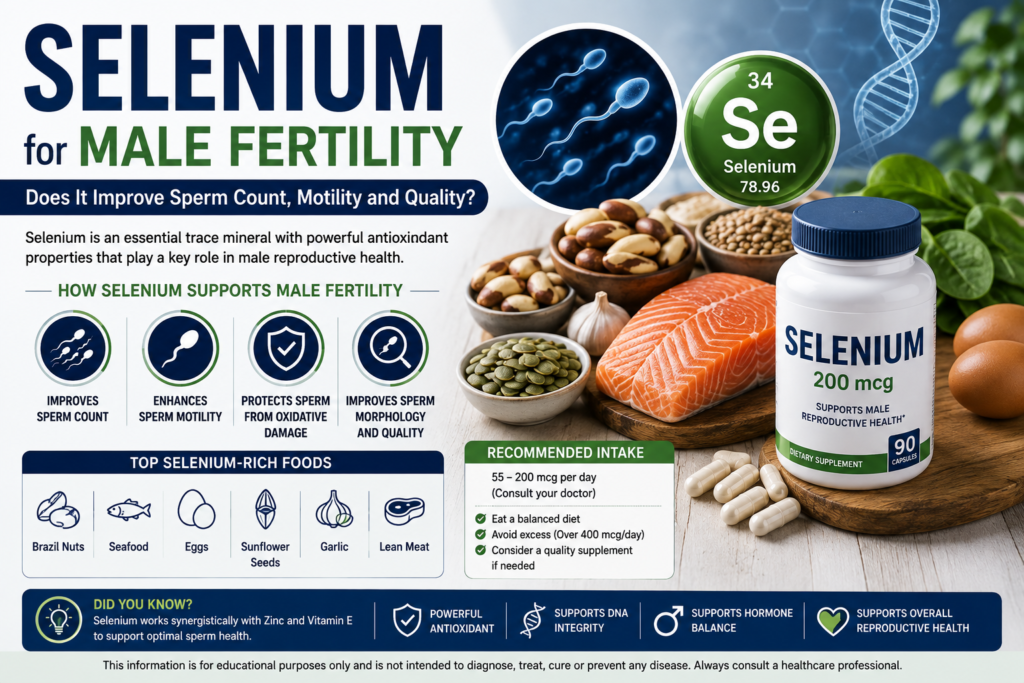
Selenium is an essential trace mineral.
Your body only requires relatively small quantities, but those small amounts are important.
Selenium becomes incorporated into specialized proteins known as selenoproteins.
These proteins participate in processes involving:
- antioxidant defense;
- thyroid hormone metabolism;
- DNA synthesis;
- immune function;
- reproduction;
- cellular protection.
Male reproductive tissues rely on several selenium-dependent biological processes.
That’s why selenium has attracted substantial scientific interest in fertility research.
Why Is Selenium Important for Male Fertility?
Sperm cells face an unusual biological challenge.
Their membranes contain high levels of polyunsaturated fatty acids, which are important for normal function but can also make them vulnerable to oxidative damage.
The body therefore needs antioxidant systems to maintain an appropriate balance.
Several selenium-dependent enzymes contribute to these defenses.
One particularly important family is:
glutathione peroxidases.
These enzymes help regulate oxidative processes and protect cells against excessive oxidative damage.
Certain selenium-containing proteins are also involved in sperm structure and development.
This creates a biologically plausible relationship between selenium status and male reproductive health.
But remember:
biological importance does not automatically mean supplementation improves fertility.
The body needs selenium within an appropriate range.
What Does Selenium Do for Sperm?
Selenium has been investigated in relation to several aspects of sperm biology, including:
- spermatogenesis;
- sperm maturation;
- sperm structure;
- mitochondrial function;
- motility;
- antioxidant defense;
- sperm membrane integrity;
- and protection against oxidative stress.
One selenium-containing enzyme of particular interest is phospholipid hydroperoxide glutathione peroxidase, also known as GPX4.
GPX4 has important functions involving sperm development and structural integrity.
This helps explain why inadequate selenium status may potentially interfere with reproductive function.
However, the relationship isn’t linear.
Increasing selenium intake beyond adequate levels doesn’t necessarily create progressively healthier sperm.
Does Selenium Increase Sperm Count?
Possibly in some men, but the evidence isn’t strong enough to make a universal claim.
Clinical studies have investigated selenium supplementation in men experiencing infertility.
Some trials have reported improvements in certain semen parameters.
But study results vary considerably depending on:
- selenium status;
- infertility diagnosis;
- dose;
- duration;
- supplement formulation;
- additional antioxidants;
- study size;
- and participant characteristics.
This makes it difficult to say:
“Take selenium and your sperm count will increase.”
A more evidence-based statement is:
Adequate selenium is important for normal male reproductive function, while supplementation may benefit certain men depending on nutritional status and other factors.
If your sperm concentration is low, don’t automatically assume selenium deficiency is responsible.
Our article on what causes low sperm count in men explains the many possible medical and lifestyle causes.
Does Selenium Improve Sperm Motility?
Motility is probably one of the most interesting areas of selenium research.
Sperm need energy and functional cellular structures to move effectively.
They also need protection against excessive oxidative damage.
Because selenium-dependent proteins participate in both sperm structure and antioxidant systems, researchers have investigated whether selenium supplementation can influence motility.
Some human studies have reported improved motility following selenium supplementation, particularly when selenium has been combined with other nutrients or antioxidants.
However, this creates an important research problem.
If a supplement contains:
- selenium;
- zinc;
- vitamin E;
- CoQ10;
- L-carnitine;
- and other ingredients,
and motility improves, it becomes difficult to determine how much of that improvement came specifically from selenium.
This is one reason supplement evidence should be interpreted cautiously.
Does Selenium Improve Sperm Morphology?
Sperm morphology refers to sperm shape and structure.
Because selenium-dependent proteins participate in sperm development, researchers have also investigated relationships between selenium and morphology.
Some supplementation studies report improvements in morphology or other semen characteristics.
Others provide less convincing results.
Morphology can also be influenced by numerous factors unrelated to selenium, including:
- genetics;
- testicular function;
- varicocele;
- smoking;
- oxidative stress;
- environmental exposures;
- illness;
- and other reproductive conditions.
Therefore, abnormal morphology shouldn’t automatically be treated with selenium.
Selenium and Oxidative Stress
Understanding oxidative stress helps explain why selenium appears in so many fertility formulas.
The body naturally produces reactive oxygen species.
Small amounts actually participate in normal sperm processes.
Problems may occur when reactive oxygen species become excessive relative to antioxidant defenses.
This is called oxidative stress.
Excessive oxidative stress may damage:
- sperm membranes;
- proteins;
- mitochondria;
- and DNA.
Because selenium is incorporated into antioxidant enzymes such as glutathione peroxidases, adequate selenium contributes to the body’s antioxidant defense system.
This provides a strong biological rationale for selenium’s role in reproductive health.
But antioxidant supplementation introduces another issue:
more antioxidant activity isn’t automatically better.
The reproductive system requires balance.
What Is the Antioxidant Paradox in Male Fertility?
Oxidative stress can harm sperm.
So it seems logical that taking lots of antioxidants should always help.
Unfortunately, biology isn’t that straightforward.
Sperm actually require controlled levels of reactive oxygen species for processes involved in normal fertilization.
Suppressing oxidative signaling excessively may potentially create another imbalance sometimes discussed as reductive stress.
This is why the goal shouldn’t be:
eliminate every free radical.
The goal is maintaining appropriate biological balance.
This is also why professional fertility guidelines remain cautious about recommending antioxidant supplements universally.
Selenium vs. Zinc for Male Fertility
Selenium and zinc are frequently combined in fertility products, but they aren’t interchangeable.
Selenium
Primarily contributes through:
- selenoproteins;
- antioxidant enzymes;
- thyroid metabolism;
- sperm structure;
- reproductive function.
Zinc
Participates in:
- DNA synthesis;
- cell division;
- sperm development;
- sperm maturation;
- reproductive hormones;
- numerous enzymes;
- and fertilization.
Both are essential.
Neither should automatically be considered superior.
Our detailed guide on zinc for male fertility explains zinc’s role in sperm count, motility, testosterone, and reproductive function.
Can You Take Selenium and Zinc Together?
Yes, selenium and zinc can be consumed together, and many foods naturally provide both nutrients.
They’re also frequently combined in male fertility supplements.
For example, Fertility Factor 5 contains both zinc and selenium alongside Tongkat Ali, Panax ginseng, and BioPerine.
However, the important question isn’t simply:
Can they be combined?
It’s:
How much are you consuming in total?
You may already be getting selenium and zinc from:
- food;
- a multivitamin;
- a fertility supplement;
- a testosterone-support supplement;
- a prostate supplement.
Taking several overlapping products can increase total intake substantially.
Always read supplement labels.
Selenium vs. CoQ10 for Sperm Health
CoQ10 and selenium both relate to cellular protection, but through different mechanisms.
CoQ10
Participates in:
- mitochondrial energy production;
- electron transport;
- antioxidant activity.
Selenium
Is incorporated into selenoproteins involved in:
- antioxidant enzymes;
- cellular protection;
- sperm development;
- thyroid metabolism.
CoQ10 has received particular attention for sperm motility because sperm movement requires substantial energy.
Selenium is especially interesting because of its structural and antioxidant roles within sperm biology.
Some fertility supplements contain both.
That doesn’t mean combining them guarantees improved fertility.
Selenium vs. L-Carnitine
L-carnitine is another popular male fertility ingredient.
It plays an important role in fatty-acid metabolism and cellular energy production.
High concentrations of carnitine are found within parts of the male reproductive tract, and researchers have investigated it extensively in relation to sperm maturation and motility.
Selenium works differently through selenium-containing proteins and antioxidant systems.
Because these nutrients affect different pathways, asking which one is “best” oversimplifies male fertility.
The correct intervention depends on the individual.
Selenium and Testosterone
Selenium is sometimes marketed as a testosterone booster.
The evidence doesn’t justify such a broad claim.
Adequate selenium is important for normal physiological function.
But that doesn’t mean taking extra selenium will substantially increase testosterone in healthy men.
Testosterone is regulated through a complex hormonal system involving:
- hypothalamus;
- pituitary gland;
- testes;
- LH;
- FSH;
- metabolic health;
- sleep;
- body composition;
- age;
- medications;
- and other factors.
If testosterone is genuinely low, identifying the underlying reason is more useful than automatically taking selenium.
Can Selenium Deficiency Affect Testosterone?
Severe nutritional deficiencies can affect numerous biological systems.
Because selenium contributes to thyroid function, antioxidant defenses, and reproductive biology, inadequate status could potentially influence broader endocrine health.
However, low testosterone has many potential causes.
Selenium deficiency shouldn’t automatically be assumed.
If symptoms and laboratory testing suggest a hormonal problem, professional evaluation is appropriate.
Does Selenium Increase Semen Volume?
There isn’t convincing evidence that selenium supplementation reliably increases ejaculate volume in men who already have adequate nutritional status.
Semen volume depends largely on fluids produced by reproductive glands.
Factors influencing semen volume can include:
- abstinence duration;
- ejaculation frequency;
- age;
- medications;
- prostate function;
- seminal-vesicle function;
- reproductive-tract abnormalities;
- and other factors.
Sperm concentration and semen volume are also different measurements.
You can have high semen volume with relatively few sperm.
If you’re researching products marketed specifically around ejaculate volume, our SemEnhance review examines this category in greater detail.
Does Selenium Improve Libido?
Selenium isn’t an established libido-enhancing treatment.
Sexual desire depends on numerous factors, including:
- hormones;
- psychological wellbeing;
- sleep;
- stress;
- relationships;
- medications;
- physical health;
- and sexual function.
Correcting a genuine nutritional deficiency may improve overall health.
But taking extra selenium when you’re already selenium-sufficient shouldn’t be expected to dramatically increase libido.
How Much Selenium Do Men Need?
According to the U.S. National Institutes of Health Office of Dietary Supplements, the Recommended Dietary Allowance for adult men and women is:
55 micrograms (mcg) per day.
Notice that selenium requirements are measured in micrograms, not milligrams.
One milligram equals:
1,000 micrograms.
That distinction is important because selenium is required in relatively small quantities.
What Is the Upper Limit for Selenium?
The traditional U.S. tolerable upper intake level for adults is:
400 mcg per day.
However, newer risk assessments from European authorities have established lower upper limits, highlighting that selenium intake deserves caution.
You generally don’t need to approach an upper limit to obtain the nutritional benefits of selenium.
Upper limits represent levels intended to reduce toxicity risk—not recommended targets.
What Happens If You Take Too Much Selenium?
Excessive selenium intake can cause selenosis, or selenium toxicity.
Symptoms may include:
- hair loss;
- brittle nails;
- garlic-like breath odor;
- metallic taste;
- nausea;
- diarrhea;
- fatigue;
- skin changes;
- nervous-system abnormalities;
- and other symptoms.
Extremely high exposure can become medically serious.
This is one reason selenium isn’t an ingredient to megadose.
Can Too Much Selenium Hurt Sperm?
Potentially.
Selenium is an excellent example of a nutrient with a U-shaped relationship to health.
Too little may impair normal biological function.
Too much can also be harmful.
Experimental and observational research suggests excessive selenium can adversely affect reproductive biology.
Therefore:
selenium deficiency isn’t desirable, but selenium excess isn’t desirable either.
The goal is adequate intake.
What Foods Are Highest in Selenium?
Selenium occurs naturally in many foods.
The amount in plant foods can vary substantially depending on the selenium content of the soil where they were grown.
Good dietary sources include:
Brazil Nuts
Brazil nuts are exceptionally rich in selenium.
In fact, they can contain so much selenium that eating large quantities regularly may lead to excessive intake.
Tuna
Tuna can provide substantial selenium along with protein and other nutrients.
Sardines
Sardines provide selenium, protein, omega-3 fatty acids, vitamin B12, and other nutrients.
Shrimp
Shellfish can contribute meaningful amounts of selenium.
Eggs
Eggs provide selenium along with protein, choline, and other nutrients.
Beef
Beef contains selenium as well as zinc, iron, protein, and vitamin B12.
Chicken and Turkey
Poultry is another useful dietary source.
Dairy Products
Milk, yogurt, and cheese can contribute selenium.
Whole Grains
Certain grain products provide selenium, although concentrations depend partly on growing conditions.
Are Brazil Nuts Good for Male Fertility?
Brazil nuts have become popular online as a “fertility food” because they’re extremely rich in selenium.
They can certainly contribute selenium to the diet.
But there’s an important catch.
The selenium concentration of individual Brazil nuts varies dramatically.
Some nuts contain very high amounts.
That means eating handfuls every day isn’t necessarily a good idea.
More Brazil nuts don’t equal more fertility.
Think of them as a concentrated selenium food rather than a fertility medicine.
How Many Brazil Nuts Should You Eat for Selenium?
There isn’t a universally reliable number because selenium content varies considerably between nuts.
A single Brazil nut may provide a substantial portion—or even more than a full day’s requirement—depending on its origin.
Therefore, routinely eating large quantities specifically to maximize selenium intake is unnecessary.
If Brazil nuts are part of your diet, moderation makes sense.
Is Selenium From Food Better Than Supplements?
For most healthy people who can meet their nutritional requirements through food, dietary sources are an excellent starting point.
Foods provide selenium alongside other nutrients.
Fish, for example, may also provide:
- omega-3 fatty acids;
- vitamin B12;
- protein;
- vitamin D in some species.
Eggs provide:
- protein;
- choline;
- vitamins;
- minerals.
Supplements can be useful when intake is inadequate or when specifically recommended.
But a supplement isn’t automatically better simply because the dose is higher.
Which Form of Selenium Is Best?
Supplements may contain forms such as:
- selenomethionine;
- selenium-enriched yeast;
- sodium selenite;
- sodium selenate.
These forms differ in metabolism and bioavailability.
Selenomethionine is commonly used because it is well absorbed.
However, choosing a highly absorbable form doesn’t mean taking a high dose is desirable.
For fertility purposes, there isn’t enough evidence to declare one selenium form universally superior for all men.
How Much Selenium Is Used in Male Fertility Supplements?
Doses vary considerably.
Some products provide amounts close to the daily requirement.
Others contain substantially more.
When evaluating a supplement, don’t look only at the selenium dose.
Consider:
- your dietary intake;
- multivitamins;
- other supplements;
- selenium form;
- total formula;
- duration of use;
- and whether you have a reason to supplement.
This becomes especially important when using several men’s-health products simultaneously.
Selenium in Male Fertility Supplements
Selenium appears in numerous male fertility formulas because its biological role is scientifically plausible.
But ingredient presence alone isn’t evidence of product effectiveness.
Suppose a supplement contains:
- selenium;
- zinc;
- CoQ10;
- L-carnitine;
- vitamin E;
- folate.
You still need to ask:
- Are the doses appropriate?
- Are ingredients transparently disclosed?
- Has the finished product been studied?
- Were meaningful fertility outcomes measured?
- Is there evidence beyond ingredient-level research?
- Is long-term intake safe?
These questions help separate reasonable formulation from marketing.
For comparisons, see our Best Male Fertility Supplements to Increase Sperm Count, Motility & Ejaculate Volume.
Selenium and Prostate Health
Selenium has also received considerable research attention in prostate health.
At one point, selenium supplements were widely discussed for potential prostate-cancer prevention.
However, large randomized trials did not demonstrate the hoped-for preventive benefit.
The SELECT trial, which examined selenium and vitamin E supplementation, is particularly important in this area.
This provides another useful lesson:
an essential nutrient with promising observational evidence isn’t automatically beneficial when given as a supplement.
For broader prostate supplement information, see our PrimeGENIX Prostate Support review.
Selenium and Thyroid Function
Selenium also plays an important role in thyroid hormone metabolism.
Several enzymes involved in thyroid hormone conversion are selenium-dependent.
This creates another connection between selenium and general endocrine health.
However, thyroid biology is complex.
Taking selenium without a reason isn’t a substitute for diagnosing and treating a thyroid disorder.
If thyroid disease is suspected, appropriate testing and medical evaluation are more useful than self-treating with high-dose selenium.
Should Men Trying to Conceive Take Selenium?
Every man needs adequate selenium.
That doesn’t mean every man needs a selenium supplement.
A fertility-focused lifestyle should begin with fundamentals:
- nutrient-dense diet;
- healthy body weight;
- regular exercise;
- adequate sleep;
- no smoking;
- avoiding anabolic steroids;
- moderating heavy alcohol use;
- appropriate management of medical conditions;
- and limiting unnecessary prolonged testicular heat.
Supplementation may be considered depending on:
- dietary intake;
- nutritional status;
- semen-analysis findings;
- other supplements;
- and professional guidance.
Can Selenium Fix Low Sperm Count?
Not if selenium isn’t the cause.
Low sperm count can be associated with:
- varicocele;
- hormonal disorders;
- genetic conditions;
- testicular injury;
- testosterone therapy;
- anabolic steroids;
- infections;
- medications;
- chemotherapy;
- radiation;
- obesity;
- smoking;
- environmental exposures;
- and other factors.
Taking selenium won’t correct all of those.
That’s why our guide on what causes low sperm count in men should be considered alongside any supplement discussion.
Can Selenium Fix Poor Sperm Motility?
Again, it depends on the cause.
If inadequate nutritional status or excessive oxidative stress contributes to impaired sperm function, selenium may theoretically play a role.
But poor motility can also result from:
- genetic abnormalities;
- varicocele;
- testicular dysfunction;
- infection;
- smoking;
- heat;
- and other factors.
Selenium shouldn’t be presented as a universal motility treatment.
How Long Does Selenium Take to Affect Sperm?
Sperm development isn’t immediate.
Spermatogenesis takes place over many weeks, followed by additional maturation.
Therefore, reproductive interventions are generally evaluated over months rather than days.
A selenium supplement taken this morning won’t meaningfully transform sperm production by tomorrow.
This is important when evaluating supplement advertisements promising rapid changes.
Our upcoming guide on how long it takes to improve sperm quality will explain the sperm-development timeline in detail.
Can Selenium Improve Male Fertility in Three Months?
Some clinical fertility studies evaluate antioxidant or micronutrient interventions over approximately three months or longer because this timeframe allows a meaningful portion of the sperm-development cycle to occur.
However, three months shouldn’t be interpreted as a guarantee.
Whether semen parameters improve depends on:
- underlying cause;
- nutritional status;
- baseline semen quality;
- health conditions;
- lifestyle;
- treatment;
- and individual biology.
Should You Test Selenium Levels?
Routine selenium testing isn’t necessary for every man trying to conceive.
It may be more relevant when there is reason to suspect inadequate or excessive selenium status.
Potential considerations include:
- highly restrictive diets;
- malabsorption;
- certain gastrointestinal disorders;
- unusual supplementation practices;
- very high Brazil-nut consumption;
- or symptoms suggesting possible toxicity.
A healthcare professional can determine whether testing is appropriate.
What If You’re Already Taking Selenium?
Check the label.
Then check every other supplement you’re taking.
Look for selenium in:
- multivitamins;
- fertility supplements;
- testosterone boosters;
- prostate supplements;
- antioxidant formulas.
Add those amounts together.
Then remember you’re also obtaining selenium from food.
This simple check can prevent accidental excessive intake.
Is More Selenium Better for Fertility?
No.
This is perhaps the most important takeaway from the entire article.
Selenium is essential.
But essential doesn’t mean unlimited.
Think of selenium as a nutrient with an optimal range.
Too little → potentially problematic
Adequate → supports normal physiology
Too much → potentially toxic
The goal isn’t maximum selenium.
The goal is appropriate selenium status.
When Should You See a Fertility Specialist?
Consider professional evaluation if:
- you’ve been trying unsuccessfully to conceive;
- sperm concentration is severely reduced;
- sperm motility is substantially impaired;
- multiple semen parameters are abnormal;
- no sperm are detected;
- you have testicular pain or swelling;
- you’re taking testosterone;
- you’ve used anabolic steroids;
- you’ve received chemotherapy or radiation;
- you have known hormonal problems;
- or you have another significant reproductive concern.
A fertility supplement shouldn’t delay appropriate evaluation when a substantial abnormality exists.
The Bottom Line
Selenium is genuinely important for male reproductive biology.
It contributes to:
- sperm development;
- sperm structure;
- antioxidant defenses;
- cellular protection;
- thyroid metabolism;
- and other physiological processes.
Some studies suggest selenium supplementation may improve certain semen parameters in selected infertile men.
But that doesn’t establish selenium as a universal fertility treatment.
The evidence supports a much more balanced conclusion:
Men need adequate selenium for normal reproductive health, but taking extra selenium doesn’t guarantee higher sperm count, better motility, increased testosterone, greater semen volume, or pregnancy.
And because excessive selenium can cause toxicity, megadosing is particularly unwise.
Focus on adequate nutrition first.
If semen parameters are abnormal, investigate the underlying cause rather than assuming a single mineral will solve the problem.
Frequently Asked Questions
Is selenium good for male fertility?
Selenium is an essential nutrient involved in normal sperm development, antioxidant defenses, and reproductive function. Adequate selenium is therefore important for male reproductive health.
Does selenium increase sperm count?
Some studies have reported improvements in semen parameters with selenium supplementation, but evidence doesn’t establish that selenium reliably increases sperm count in every man.
Does selenium improve sperm motility?
Selenium-dependent proteins are important for sperm structure and antioxidant defense, and some clinical studies have reported motility improvements. Results aren’t universal.
How much selenium should a man get daily?
The U.S. RDA for adults is 55 mcg per day.
Is 200 mcg of selenium safe?
Two hundred micrograms is below the traditional U.S. adult upper intake level of 400 mcg/day, but it’s substantially above the RDA. Whether supplementation is appropriate depends on total dietary and supplemental intake.
Is 400 mcg of selenium too much?
Four hundred micrograms represents the traditional U.S. adult tolerable upper intake level, not a recommended daily target. Regularly approaching the upper limit without a medical reason isn’t advisable.
Can too much selenium be harmful?
Yes. Excessive selenium can cause selenosis, which may involve hair loss, brittle nails, gastrointestinal symptoms, garlic-like breath, fatigue, and neurological effects.
Are Brazil nuts good for sperm?
Brazil nuts provide selenium and other nutrients, but there’s no evidence that eating large quantities automatically improves sperm. Their selenium content can be extremely high and variable.
How many Brazil nuts should men eat daily?
There isn’t a precise universal number because selenium concentration varies substantially between individual nuts. Large daily quantities aren’t necessary and could produce excessive selenium intake.
Is selenium better than zinc for fertility?
No universal evidence establishes one as better. Zinc and selenium perform different essential biological functions.
Can I take zinc and selenium together?
Yes, but consider total intake from food and all supplements to avoid excessive consumption.
Does selenium increase testosterone?
Selenium is necessary for normal physiology but isn’t established as a reliable testosterone booster in selenium-sufficient men.
Does selenium increase semen volume?
There isn’t strong evidence that extra selenium reliably increases ejaculate volume.
How long does selenium take to improve sperm?
If selenium affects semen parameters, meaningful changes would generally be evaluated over weeks to months because sperm development takes considerable time.
Should every man trying for a baby take selenium?
No. Every man requires adequate selenium nutrition, but not every man needs a selenium supplement.
Related Articles on Fitness Donkey
Scientific Sources & References
- NIH Office of Dietary Supplements — Selenium Fact Sheet for Health Professionals
- NCBI/PMC — Selenium and Male Reproduction
- PubMed — Selenium and Male Reproduction
- NCBI/PMC — The Role of Selenium in Male Fertility
- American Urological Association — Diagnosis and Treatment of Infertility in Men: AUA/ASRM Guideline
- World Health Organization — WHO Laboratory Manual for the Examination and Processing of Human Semen, 6th Edition
- Cochrane — Antioxidants for Male Subfertility
- National Cancer Institute — Selenium and Vitamin E Cancer Prevention Trial (SELECT)
Medical Disclaimer
This article is for informational and educational purposes only and isn’t intended to diagnose, treat, cure, or prevent infertility, selenium deficiency, or another medical condition.
Selenium is essential but can be harmful in excessive amounts. Supplement requirements vary depending on diet, nutritional status, medications, health conditions, and other sources of selenium.
If you have abnormal semen-analysis results, suspected selenium deficiency or toxicity, or persistent difficulty conceiving, consider discussing your situation with an appropriately qualified healthcare professional.