If you’re trying to conceive, sperm count is one of several important measures of male reproductive health. But having a lower-than-expected sperm count doesn’t necessarily mean pregnancy is impossible—and taking a handful of supplements isn’t automatically the solution.
Sperm production is influenced by a surprisingly broad range of factors, including overall health, body weight, smoking, alcohol use, diet, sleep, medications, hormones, heat exposure, and certain medical conditions.
The encouraging part is that some of these factors are modifiable.
In this guide, we’ll look at practical, evidence-based ways to support sperm production naturally, what the research actually says, how long changes may take, and when it’s worth getting a professional fertility evaluation.
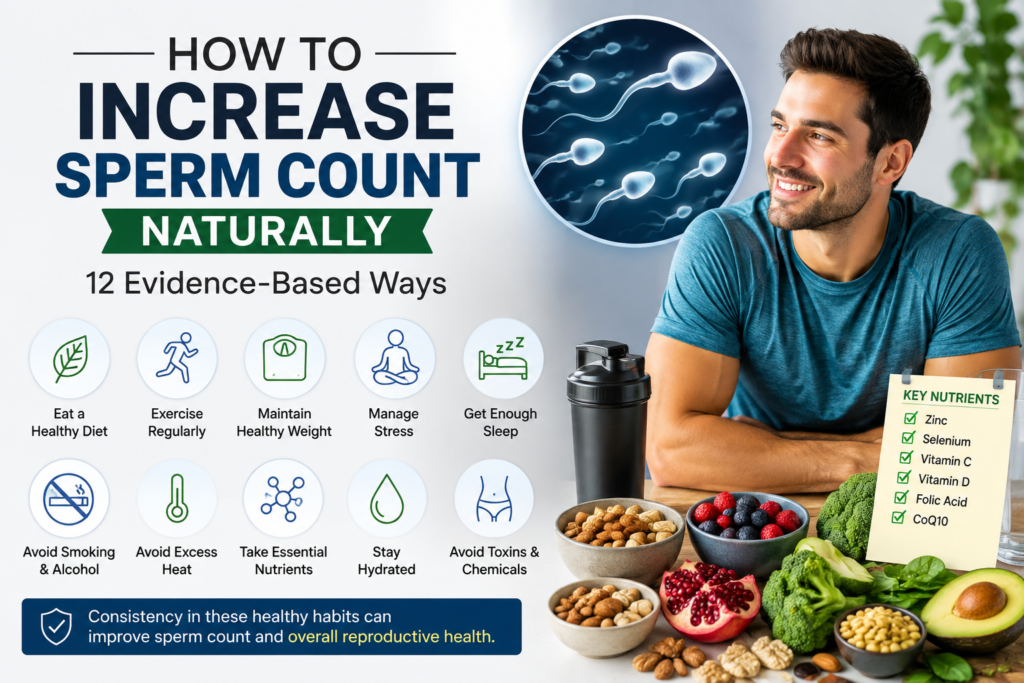
Quick answer: Maintaining a healthy weight, eating a nutrient-dense diet, exercising regularly, avoiding smoking and recreational drugs, moderating alcohol, getting adequate sleep, limiting excessive testicular heat, and addressing underlying health problems may help support male reproductive health. However, no lifestyle change can guarantee a higher sperm count, particularly when an underlying medical, hormonal, anatomical, or genetic condition is responsible.
What Is Sperm Count?
Sperm count refers to the number of sperm present in an ejaculate.
You’ll also commonly encounter the term sperm concentration, which refers to the number of sperm per milliliter of semen.
These terms are related but aren’t exactly the same.
A semen analysis can evaluate several characteristics, including:
- semen volume;
- sperm concentration;
- total sperm number;
- sperm motility;
- sperm morphology;
- and other laboratory characteristics.
The World Health Organization publishes standardized procedures for semen examination in its laboratory manual.
Importantly, fertility cannot be determined from sperm count alone.
A man’s semen analysis may contain several measurements, and fertility itself depends on factors involving both partners.
What Is Considered a Normal Sperm Count?
This question is more complicated than simply drawing a line between “fertile” and “infertile.”
Laboratory reference values are useful for interpreting semen analysis, but they shouldn’t be treated as a perfect fertility test.
A result below a reference limit doesn’t automatically mean a man cannot conceive naturally.
Likewise, having results above reference limits doesn’t guarantee pregnancy.
This is one reason fertility specialists consider the complete semen analysis, reproductive history, physical examination when indicated, partner factors, and other clinical information.
We’ll cover this subject separately in our guide to what is considered a normal sperm count.
Can You Increase Sperm Count Naturally?
Sometimes lifestyle changes may improve aspects of reproductive health, but the answer depends heavily on why sperm count is low.
Consider two very different situations.
A man whose reproductive health is being affected by smoking, obesity, poor sleep, excessive alcohol intake, or another modifiable factor may potentially benefit from changing that factor.
But lifestyle changes aren’t going to correct every cause of low sperm production.
Low sperm count can also be associated with:
- varicocele;
- hormonal disorders;
- genetic abnormalities;
- testicular injury;
- certain infections;
- obstruction;
- medications;
- anabolic steroid use;
- testosterone therapy;
- cancer treatments;
- and other medical conditions.
That’s why persistent fertility problems shouldn’t simply be treated as a nutritional issue.
With that distinction in mind, here are some of the most practical ways to support male reproductive health.
1. Stop Smoking
If you smoke and you’re trying to conceive, quitting is one of the most sensible health changes you can make.
Research has repeatedly associated cigarette smoking with poorer measures of semen quality.
Smoking may contribute to reproductive problems through several mechanisms, including oxidative stress and potential damage affecting sperm.
This doesn’t mean every smoker is infertile.
It means smoking represents an avoidable exposure associated with poorer reproductive health.
And the benefits of quitting extend far beyond fertility.
What about vaping?
Don’t assume vaping is automatically harmless to reproductive health simply because there is no cigarette smoke.
Research into electronic cigarettes and reproductive outcomes continues to develop, and uncertainty isn’t the same as proof of safety.
If conception is the goal, reducing unnecessary nicotine and tobacco exposure is a reasonable strategy.
2. Maintain a Healthy Body Weight
Body weight and reproductive health appear to be connected.
Obesity can influence:
- hormonal regulation;
- testosterone;
- inflammation;
- oxidative stress;
- testicular temperature;
- sexual function;
- and potentially semen parameters.
Recent reviews of male fertility risk factors continue to identify obesity as an important lifestyle-associated factor.
That doesn’t mean becoming extremely lean will automatically improve fertility.
The goal should be healthy body composition and metabolic health, not crash dieting.
If you’re significantly overweight, gradual and sustainable weight loss through improved nutrition and regular physical activity may support both reproductive and overall health.
3. Exercise Regularly
Regular physical activity is one of the foundations of general health, and it may also support male reproductive health.
Exercise can contribute to:
- healthier body weight;
- better insulin sensitivity;
- cardiovascular health;
- improved metabolic health;
- stress management;
- and healthier hormonal regulation.
Research reviews have associated regular physical activity with potentially better reproductive parameters.
But more isn’t always better.
Can too much exercise hurt fertility?
Potentially.
Extremely intensive training combined with inadequate calorie intake, poor recovery, or other stressors may interfere with hormonal and reproductive function.
Certain activities may also create prolonged heat or pressure around the testicular area.
For most men, however, the goal should simply be consistent moderate-to-vigorous exercise appropriate for their health and fitness level.
4. Improve the Quality of Your Diet
There isn’t one magical “sperm-count diet.”
A better approach is to improve overall dietary quality.
Research into male fertility has examined dietary patterns containing:
- vegetables;
- fruits;
- nuts;
- whole grains;
- legumes;
- fish;
- healthy fats;
- and other nutrient-dense foods.
These foods provide vitamins, minerals, fatty acids, antioxidants, fiber, and other compounds relevant to general health.
In contrast, dietary patterns dominated by highly processed foods, excessive calories, and poor nutrient density may contribute indirectly through obesity and metabolic dysfunction.
Foods associated with a fertility-friendly diet
A practical grocery list might include:
- leafy green vegetables;
- berries;
- citrus fruits;
- tomatoes;
- beans and lentils;
- walnuts and other nuts;
- seeds;
- eggs;
- fish;
- whole grains;
- olive oil;
- and other minimally processed foods.
Don’t obsess over a single “fertility superfood.”
Your overall dietary pattern matters more.
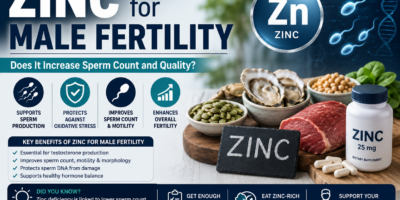
5. Get Enough Zinc From Your Diet
Zinc is particularly relevant to male reproductive biology.
The mineral participates in numerous biological processes and has been studied extensively in connection with:
- spermatogenesis;
- sperm maturation;
- sperm motility;
- reproductive hormones;
- and fertilization.
This is one reason zinc frequently appears in male fertility supplements.
Food sources of zinc include:
- oysters and other shellfish;
- meat;
- poultry;
- dairy products;
- beans;
- nuts;
- seeds;
- and fortified foods.
Should you take a zinc supplement?
Not automatically.
If inadequate zinc intake is contributing to poor nutritional status, correcting that problem makes biological sense.
But that doesn’t mean taking increasingly large doses will continually increase sperm count.
More isn’t necessarily better.
We examine this issue in greater depth in our guide to zinc for male fertility and sperm health.
6. Pay Attention to Selenium
Selenium is another trace mineral relevant to normal reproductive physiology.
It contributes to antioxidant systems and has been investigated in connection with sperm development and function.
Food sources can include:
- seafood;
- meat;
- poultry;
- eggs;
- dairy products;
- grains;
- and Brazil nuts.
But selenium deserves caution because the body only needs relatively small quantities.
Excessive intake can be harmful.
This is another example of why blindly combining multiple fertility supplements isn’t necessarily a good idea.
We’ll examine the research separately in our guide to selenium and male fertility.
7. Don’t Overlook Sleep
Sleep affects far more than energy levels.
Poor or insufficient sleep can influence:
- metabolic health;
- appetite;
- stress;
- body weight;
- hormonal regulation;
- cardiovascular health;
- and overall wellbeing.
Sleep disorders and poor sleep have also attracted increasing attention in research on male reproductive health.
You don’t need to chase a magical number of hours specifically for sperm production.
Instead, prioritize consistent, adequate, high-quality sleep as part of your overall health strategy.
If you regularly snore heavily, wake unrefreshed, experience excessive daytime sleepiness, or suspect sleep apnea, discussing it with a healthcare professional may be worthwhile.
8. Reduce Excessive Alcohol Consumption
The relationship between alcohol and fertility can depend on the amount and pattern of consumption.
Heavy or chronic alcohol consumption is a clearer concern than occasional drinking.
Excessive alcohol intake may affect:
- reproductive hormones;
- testicular function;
- sexual function;
- general health;
- and semen parameters.
If you’re actively trying to optimize fertility, reducing heavy alcohol consumption is a sensible step.
That doesn’t mean a single drink makes a man infertile.
As with many lifestyle factors, dose and frequency matter.
9. Avoid Anabolic Steroids and Unsupervised Testosterone
This is one of the most important—and frequently misunderstood—points in male fertility.
Men often associate testosterone with masculinity and fertility.
So it seems logical to assume:
More testosterone = more sperm.
Unfortunately, that’s not how the reproductive system works.
Taking external testosterone can suppress the hormonal signals needed for sperm production.
The same concern applies to anabolic-androgenic steroids.
For a man trying to conceive, using testosterone without appropriate medical supervision can therefore be counterproductive.
Current male infertility guidelines specifically caution against testosterone monotherapy in men interested in current or future fertility.
If you’re taking testosterone and want children, don’t abruptly alter prescribed treatment yourself. Discuss your fertility goals with the clinician managing your treatment.
10. Avoid Excessive Testicular Heat
The testes are located outside the abdominal cavity for a biological reason: sperm production functions best within an appropriate temperature range.
Researchers have therefore investigated whether repeated or prolonged heat exposure may affect semen quality.
Potential sources of testicular heat include:
- frequent hot tubs;
- prolonged sauna exposure;
- certain occupational environments;
- prolonged direct heat;
- and situations that significantly raise scrotal temperature.
This doesn’t mean sitting in a hot bath once will destroy your fertility.
The bigger concern is repeated or sustained excessive heat exposure, particularly in someone already experiencing impaired semen parameters.
What about laptops?
Rather than panicking about occasional laptop use, avoid placing a hot laptop directly against the groin for prolonged periods.
A desk or laptop stand is an easy solution.
11. Manage Chronic Stress
“Just relax” is terrible fertility advice.
Infertility itself can be stressful, and telling someone that stress is the entire reason they aren’t conceiving can make the situation worse.
However, chronic psychological stress can influence:
- sleep;
- sexual function;
- lifestyle choices;
- hormonal systems;
- relationship wellbeing;
- and overall health.
Research has investigated associations between psychological stress and male reproductive parameters, although the relationship is complex.
Stress reduction therefore shouldn’t be sold as a fertility cure.
Think of it as one component of maintaining better overall physical and reproductive health.
Useful approaches may include:
- regular exercise;
- adequate sleep;
- time outdoors;
- relaxation techniques;
- addressing excessive workloads;
- counseling or therapy when appropriate;
- and maintaining social connections.
12. Review Your Medications and Supplements
Sometimes the problem isn’t what you aren’t taking.
It’s something you already take.
Certain medications and drugs can affect:
- sperm production;
- ejaculation;
- sexual function;
- reproductive hormones;
- or other aspects of fertility.
This doesn’t mean you should stop a prescribed medication because you read that it might affect fertility.
That can be dangerous.
Instead, tell your doctor that you’re trying to conceive and ask whether any current medications could affect reproductive health.
The same applies to supplements.
“Natural” doesn’t automatically mean fertility-friendly.
Do Male Fertility Supplements Increase Sperm Count?
This is where marketing often gets ahead of science.
Male fertility supplements commonly contain ingredients such as:
- zinc;
- selenium;
- CoQ10;
- L-carnitine;
- folate;
- vitamin C;
- vitamin E;
- omega-3 fatty acids;
- ashwagandha;
- Tongkat Ali;
- and various antioxidants.
Some of these ingredients have interesting research behind them.
But there’s a major distinction between:
an ingredient participating in reproductive biology
and
a commercial supplement being clinically proven to increase the chance of pregnancy.
Those aren’t equivalent claims.
Professional male infertility guidance remains cautious about the clinical utility of antioxidant and vitamin supplements because evidence is not strong enough to recommend specific agents universally.
If you’re considering supplementation, see our Best Male Fertility Supplements to Increase Sperm Count, Motility and Ejaculate Volume guide for a comparison of commonly marketed formulas.
You can also read our Fertility Factor 5 review for a closer examination of Tongkat Ali, zinc, selenium, Panax ginseng, and BioPerine.
What About Tongkat Ali?
Tongkat Ali (Eurycoma longifolia) is particularly popular in men’s health supplements.
It has been researched in connection with:
- male reproductive health;
- testosterone;
- libido;
- sexual function;
- and semen parameters.
Some human research is encouraging, but Tongkat Ali shouldn’t be described as a guaranteed treatment for low sperm count.
The type of extract, dosage, participant population, and study design all matter.
We’ll examine the research separately in our dedicated Tongkat Ali for male fertility guide.
What About CoQ10?
Coenzyme Q10 is involved in cellular energy production and also has antioxidant properties.
It has attracted substantial interest in male fertility research, particularly regarding sperm motility and oxidative stress.
Some studies report improvements in semen parameters, but improvements in laboratory measurements don’t necessarily establish higher pregnancy or live-birth rates.
That’s an important distinction whenever evaluating fertility supplements.
What About Ashwagandha?
Ashwagandha is frequently marketed for testosterone, stress, and male fertility.
There is preliminary clinical research involving reproductive parameters, but the evidence isn’t strong enough to describe ashwagandha as a proven treatment for male infertility.
Again, promising and proven aren’t the same thing.
How Long Does It Take to Increase Sperm Count?
Don’t expect sperm biology to change overnight.
Sperm production and maturation are biological processes that occur over an extended period.
That means a lifestyle change you started last Monday shouldn’t be judged based on a semen analysis the following Friday.
When clinicians evaluate changes in reproductive health, enough time needs to pass for those changes to potentially influence sperm development.
This is also why fertility products promising dramatic sperm-count increases within a few days deserve skepticism.
We’ll cover timing in detail in our guide to how long it takes to improve sperm quality.
Does Ejaculating Less Increase Sperm Count?
Abstinence can affect semen-analysis measurements.
Going longer between ejaculations may increase certain measures such as semen volume and sperm concentration in an individual sample, but that doesn’t necessarily mean overall fertility has improved.
Longer abstinence isn’t automatically better.
Sperm motility and DNA integrity can also matter.
For couples trying to conceive naturally, sexual timing should focus on the fertile window rather than simply “saving sperm” for long periods.
Does Drinking More Water Increase Sperm Count?
Hydration is important for general health, but drinking gallons of water isn’t a proven method for dramatically increasing sperm production.
Dehydration may influence fluid balance, but sperm production depends on much more complex biological processes.
Remember:
semen volume ≠ sperm count.
Increasing fluid intake doesn’t necessarily increase the number of sperm being produced.
Does Semen Volume Mean You Have More Sperm?
Not necessarily.
Semen contains much more than sperm cells.
Much of ejaculate volume comes from fluids produced by reproductive glands.
A man can therefore have relatively high semen volume but low sperm concentration.
Another man may have lower semen volume but a different sperm concentration.
This is why visual inspection of semen isn’t a reliable substitute for laboratory analysis.
For more information, read our guide to normal semen volume and what affects it.
What Is the Fastest Way to Increase Sperm Count?
There isn’t a scientifically established overnight method.
If sperm production is impaired because of a correctable factor, identifying and addressing that factor is more useful than searching for the fastest supplement.
That might mean:
- quitting smoking;
- improving diet;
- losing excess weight;
- stopping anabolic steroids under medical guidance;
- treating a medical condition;
- addressing a varicocele;
- correcting a nutritional deficiency;
- reviewing medications;
- or another individualized intervention.
The correct solution depends on the cause.
When Should You Get a Semen Analysis?
A semen analysis is one of the central components of male fertility evaluation.
AUA/ASRM guidance recommends that the initial evaluation of a male partner include reproductive history and one or more semen analyses.
A semen analysis can provide information about:
- semen volume;
- sperm concentration;
- total sperm number;
- motility;
- morphology;
- and other characteristics.
If results are abnormal, appropriate professional evaluation can help determine whether further investigation is necessary.
When Should You See a Fertility Specialist?
Don’t spend months or years cycling through supplements if there may be an underlying medical issue.
Professional evaluation becomes particularly important when:
- a couple has experienced persistent difficulty conceiving;
- semen-analysis results are abnormal;
- sperm count is very low;
- no sperm are detected;
- there is testicular pain or swelling;
- there is a history of testicular injury;
- you have undergone chemotherapy or radiation;
- you use or previously used anabolic steroids;
- you take testosterone;
- you have known hormonal problems;
- you have sexual or ejaculatory dysfunction;
- or you have another reproductive-health concern.
Male and female fertility factors can coexist.
Current professional guidance recommends concurrent evaluation of both partners when a couple is being evaluated for infertility.
Can You Really Improve Sperm Count Naturally?
For some men, improving modifiable lifestyle factors may support better reproductive health and possibly improve semen parameters.
The fundamentals aren’t glamorous:
Don’t smoke.
Maintain a healthy weight.
Exercise.
Eat well.
Sleep properly.
Avoid excessive alcohol.
Avoid anabolic steroids and inappropriate testosterone use.
Limit unnecessary excessive heat exposure.
Address underlying medical problems.
Don’t assume supplements can compensate for everything else.
And perhaps most importantly:
Find out what’s actually causing the problem.
Low sperm count is a laboratory finding—not a diagnosis explaining why the count is low.
If you’re concerned about fertility, appropriate evaluation can provide far more useful information than guessing based on symptoms or buying one supplement after another.
Frequently Asked Questions
Can sperm count increase naturally?
Potentially. Lifestyle changes may support reproductive health in some men, particularly when modifiable factors such as smoking, obesity, poor nutrition, heavy alcohol use, inadequate sleep, or certain exposures are involved. However, medical, genetic, hormonal, or anatomical causes may require professional treatment.
What foods produce sperm fast?
No individual food has been proven to rapidly produce large quantities of sperm. A balanced dietary pattern containing fruits, vegetables, nuts, whole grains, healthy fats, adequate protein, and nutrient-rich foods is a more evidence-based approach.
Which vitamin is best for sperm?
There isn’t one universally “best” fertility vitamin. Nutrients including zinc, selenium, folate, vitamins C and E, and others have been investigated in reproductive health, but supplementation needs depend on the individual.
Does zinc increase sperm count?
Zinc is essential to normal male reproductive biology, but supplementation isn’t guaranteed to increase sperm count in every man. Correcting inadequate zinc intake is different from taking excessive zinc when nutritional status is already adequate.
Does exercise increase sperm count?
Regular exercise and healthy body composition may support reproductive health. However, extremely intensive training, inadequate recovery, anabolic steroid use, and other factors associated with some training practices can negatively affect fertility.
Can lack of sleep reduce sperm count?
Sleep disturbances have been associated with poorer reproductive health in research, although fertility is influenced by many factors. Consistent, adequate sleep is sensible for both general and reproductive health.
Does smoking lower sperm count?
Smoking has been associated with poorer semen quality and other reproductive-health concerns. Quitting is advisable for general health as well as potential reproductive benefits.
Can alcohol lower sperm count?
Heavy or chronic alcohol consumption may negatively affect reproductive hormones, testicular function, and semen parameters. The effects of lower levels of alcohol consumption are less straightforward.
Does testosterone increase sperm count?
External testosterone can actually suppress sperm production. Men interested in current or future fertility should discuss testosterone therapy with an appropriately qualified clinician.
Does masturbation reduce sperm count?
Frequent ejaculation can temporarily influence semen-analysis measurements, but masturbation doesn’t permanently “use up” sperm. The body continuously produces sperm.
Can low sperm count still result in pregnancy?
Yes. Low sperm count doesn’t automatically mean natural conception is impossible. Fertility depends on multiple male and female factors, and the degree and cause of the abnormality matter.
How can I check my sperm count?
A laboratory semen analysis is the standard way to evaluate sperm concentration and other semen parameters. Visual inspection of semen cannot reliably tell you your sperm count.
Related Articles on Fitness Donkey
Scientific Sources & References
- World Health Organization — WHO Laboratory Manual for the Examination and Processing of Human Semen, 6th Edition
- AUA/ASRM — Diagnosis and Treatment of Infertility in Men: Guideline Part I
- PubMed — Can Lifestyle Changes Significantly Improve Male Fertility?
- NCBI/PMC — Lifestyle Causes of Male Infertility
- PubMed — Implications of Lifestyle Factors on Male Reproductive Health
- NCBI/PMC — Lifestyle and Fertility: The Influence of Stress and Quality of Life on Male Fertility
- NCBI/PMC — Male Infertility: Lifestyle Factors and Complementary Therapies
Editorial Note
This article is intended for educational purposes and does not replace personalized medical advice, diagnosis, or treatment. Male fertility problems can have nutritional, hormonal, genetic, anatomical, environmental, medication-related, and lifestyle causes.
If you are concerned about fertility or have abnormal semen-analysis results, consider discussing them with an appropriately qualified healthcare professional.