Tongkat Ali has become one of the most recognizable herbal ingredients in men’s health supplements.
Also known as Eurycoma longifolia, Tongkat Ali is commonly marketed for testosterone, libido, sexual performance, energy, stress, and male fertility. You’ll also find it in fertility formulas that claim to support sperm count and motility.
Some of these claims have a scientific basis worth examining. Human studies have investigated Tongkat Ali extracts for testosterone, male sexual health, stress, and semen parameters.
But there’s an important difference between an ingredient having promising research and being a proven treatment for male infertility.
This guide examines what the research says about Tongkat Ali for sperm count, motility, testosterone, fertility, dosage, safety, and how it compares with other popular male fertility ingredients.
Quick answer: Tongkat Ali has been investigated for male reproductive health, and some human studies have reported improvements in semen parameters or testosterone-related outcomes in selected populations. However, the evidence base remains relatively limited, and Tongkat Ali shouldn’t be considered a proven treatment for male infertility. Men with persistently abnormal semen parameters should investigate the underlying cause rather than relying exclusively on supplements.
What Is Tongkat Ali?
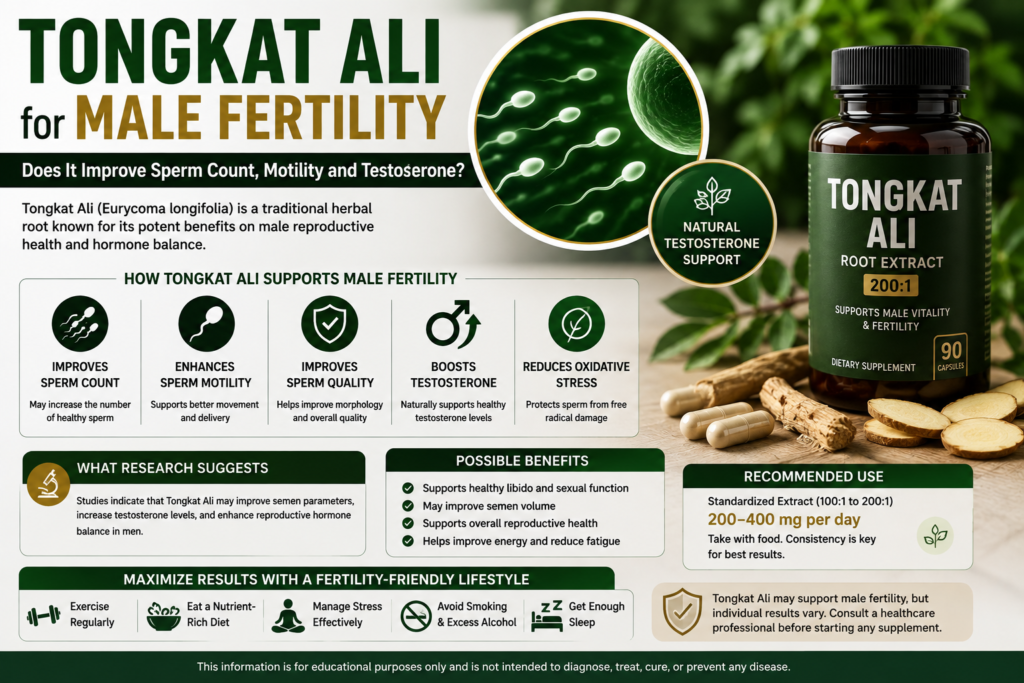
Tongkat Ali is the common name for Eurycoma longifolia, a plant native to parts of Southeast Asia.
It has a long history of traditional use and has become increasingly popular internationally as an ingredient in men’s health supplements.
The root is the part most commonly used in extracts.
Depending on the product, Tongkat Ali may be sold as:
- powdered root;
- concentrated root extract;
- standardized extract;
- capsules;
- tablets;
- combination supplements.
Modern research has investigated Tongkat Ali in relation to several areas of men’s health, including:
- testosterone;
- male fertility;
- sperm quality;
- libido;
- sexual function;
- stress;
- physical performance;
- and general wellbeing.
However, different extracts aren’t necessarily equivalent.
That distinction becomes extremely important when interpreting clinical research.
Why Is Tongkat Ali Used for Male Fertility?
Tongkat Ali’s reputation as a male fertility herb comes partly from traditional use and partly from modern research.
Scientists have investigated compounds within Eurycoma longifolia that may interact with biological pathways relevant to male reproductive health.
Research has explored potential effects involving:
- androgen status;
- testosterone;
- spermatogenesis;
- sperm concentration;
- sperm motility;
- libido;
- sexual function;
- and stress hormones.
These potential effects make Tongkat Ali an attractive ingredient for male fertility supplements.
But biological plausibility isn’t enough.
The more important question is whether properly designed human studies demonstrate meaningful fertility benefits.
Does Tongkat Ali Increase Sperm Count?
Some research suggests Tongkat Ali may influence semen parameters in certain men.
One frequently discussed study involved men with idiopathic infertility who received a standardized water-soluble extract of Eurycoma longifolia.
Researchers reported improvements in certain semen parameters over the treatment period.
The findings generated substantial interest because they suggested Tongkat Ali might have applications beyond testosterone and libido.
However, several limitations need to be considered.
The evidence base is relatively small compared with established medical fertility treatments.
Studies may also differ in:
- extract type;
- dose;
- duration;
- participant population;
- baseline fertility;
- study design;
- and outcomes measured.
Therefore, it’s too strong to say:
Tongkat Ali will increase sperm count.
A more defensible conclusion is:
Some human evidence suggests standardized Tongkat Ali extracts may influence semen parameters in selected populations, but more high-quality research is needed.
If your sperm concentration is low, read our guide on what causes low sperm count in men before assuming a herbal supplement is the solution.
Does Tongkat Ali Improve Sperm Motility?
Sperm motility describes the ability of sperm to move.
It’s particularly important because sperm need to travel through the female reproductive tract to participate in natural fertilization.
Some Tongkat Ali fertility research has reported improvements involving motility.
That’s promising, but the same limitations apply.
A result obtained using one standardized extract cannot automatically be applied to:
- every Tongkat Ali powder;
- every extract ratio;
- every supplement brand;
- every dose;
- or every man experiencing poor motility.
If motility is abnormal, lifestyle and medical factors should also be considered.
Our guide on how to improve sperm motility naturally covers smoking, obesity, exercise, nutrition, heat exposure, sleep, alcohol, CoQ10, L-carnitine, zinc, selenium, and other factors.
Does Tongkat Ali Improve Sperm Morphology?
Morphology refers to sperm shape and structure.
Although Tongkat Ali research has investigated overall semen quality, evidence specifically establishing a reliable improvement in abnormal sperm morphology is limited.
Morphology can be influenced by many factors, including:
- testicular function;
- genetics;
- oxidative stress;
- varicocele;
- smoking;
- environmental exposures;
- illness;
- and other reproductive conditions.
A herbal supplement therefore shouldn’t be assumed to correct abnormal morphology automatically.
Can Tongkat Ali Treat Male Infertility?
Tongkat Ali should not currently be described as a proven treatment for male infertility.
That’s an important distinction.
Male infertility can result from:
- varicocele;
- hormonal disorders;
- genetic abnormalities;
- obstruction;
- testicular injury;
- infections;
- testosterone therapy;
- anabolic steroid use;
- chemotherapy;
- radiation;
- medications;
- lifestyle factors;
- or unexplained causes.
Tongkat Ali cannot reasonably be expected to correct all of these.
For example, a supplement isn’t going to remove a reproductive-tract obstruction or correct a chromosomal abnormality.
This is why identifying the cause of infertility matters more than simply finding an ingredient associated with sperm health.
Does Tongkat Ali Increase Testosterone?
This is probably the best-known claim associated with Tongkat Ali.
Several human studies and systematic reviews have investigated Eurycoma longifolia and testosterone.
Some evidence suggests supplementation may increase testosterone in certain populations, particularly men with lower testosterone or specific health characteristics.
A systematic review and meta-analysis published in Molecules evaluated clinical trials examining Tongkat Ali and testosterone.
The authors found evidence suggesting supplementation could influence total testosterone, although they also emphasized the need for additional research.
That doesn’t mean Tongkat Ali acts like prescription testosterone.
And it doesn’t mean every healthy man taking Tongkat Ali will experience a large testosterone increase.
Does More Testosterone Mean More Sperm?
Not necessarily.
This is where male fertility becomes counterintuitive.
Testosterone is essential for sperm production.
But blood testosterone isn’t the only factor controlling spermatogenesis.
Sperm production depends on the hypothalamic-pituitary-gonadal axis and hormones including:
- GnRH;
- LH;
- FSH;
- and testosterone within the testes.
This is why simply increasing circulating testosterone doesn’t necessarily produce more sperm.
In fact, external testosterone therapy can suppress sperm production.
That’s an important distinction between supporting endogenous hormonal function and taking exogenous testosterone.
Tongkat Ali vs. Testosterone Therapy for Fertility
Tongkat Ali and prescription testosterone shouldn’t be treated as equivalent.
Tongkat Ali
Is a botanical supplement investigated for possible effects on endogenous hormonal and reproductive function.
Testosterone Therapy
Provides external testosterone.
External testosterone can suppress LH and FSH signaling, reducing intratesticular testosterone and potentially dramatically suppressing sperm production.
AUA/ASRM male infertility guidance specifically advises against testosterone monotherapy in men interested in current or future fertility.
If you’re trying to conceive while using testosterone, speak with the clinician managing your treatment.
Do not replace prescribed treatment with Tongkat Ali without medical guidance.
Can Tongkat Ali Increase Free Testosterone?
Some studies have evaluated total testosterone, while others have investigated broader hormonal outcomes.
Evidence regarding free testosterone specifically is less consistent and depends on the study population and methodology.
Free testosterone can also be affected by:
- total testosterone;
- sex hormone-binding globulin;
- age;
- obesity;
- thyroid function;
- liver health;
- medications;
- and other factors.
Therefore, a supplement advertisement claiming a predictable percentage increase in free testosterone should be evaluated carefully.
Does Tongkat Ali Increase LH?
Tongkat Ali is sometimes claimed to increase luteinizing hormone.
The proposed mechanism is attractive because LH stimulates Leydig cells within the testes to produce testosterone.
However, human evidence demonstrating a consistent clinically significant increase in LH isn’t strong enough to make this a guaranteed effect.
Tongkat Ali’s potential hormonal actions may be more complex than simply increasing one hormone.
Does Tongkat Ali Increase FSH?
FSH is particularly relevant to male fertility because it acts on Sertoli cells and supports spermatogenesis.
Claims that Tongkat Ali reliably increases FSH are not established strongly enough to treat the herb as an FSH-stimulating fertility treatment.
Men with abnormal FSH levels should investigate the underlying reason.
Very high or very low FSH can provide important information about testicular and pituitary function.
Tongkat Ali and Idiopathic Male Infertility
One area where Tongkat Ali has attracted particular interest is idiopathic infertility.
Idiopathic means that conventional evaluation hasn’t identified a clear cause.
This can be extremely frustrating.
A man may have abnormal semen parameters without an obvious:
- obstruction;
- genetic diagnosis;
- major hormonal disorder;
- or identifiable anatomical problem.
Some Tongkat Ali research has focused on this population.
The results are interesting because they suggest standardized extracts might influence reproductive parameters.
However, relatively small studies shouldn’t be interpreted as definitive proof of treatment efficacy.
Does Tongkat Ali Improve Pregnancy Rates?
This question matters much more than supplement marketing often acknowledges.
Improving:
sperm concentration
or
motility
is useful.
But couples ultimately care about outcomes such as:
pregnancy
and ultimately:
healthy live birth.
Some Tongkat Ali fertility research has reported pregnancies among partners of participants.
However, available evidence isn’t sufficiently robust to conclude that Tongkat Ali reliably increases pregnancy or live-birth rates.
Larger randomized controlled trials would provide stronger evidence.
This distinction applies to many fertility supplements—not just Tongkat Ali.
Tongkat Ali and Sperm DNA
Sperm DNA integrity is another increasingly researched aspect of male fertility.
Traditional semen analysis evaluates:
- concentration;
- motility;
- morphology;
- volume.
But these parameters don’t provide a complete picture of sperm molecular health.
Oxidative stress may contribute to sperm DNA damage.
Although Tongkat Ali contains bioactive compounds that have been investigated for antioxidant-related properties, evidence demonstrating that supplementation reliably improves sperm DNA fragmentation in humans remains limited.
It shouldn’t currently be marketed as a proven sperm-DNA treatment.
Tongkat Ali and Oxidative Stress
Oxidative stress occurs when reactive oxygen species exceed the body’s antioxidant defenses.
Excessive oxidative stress may damage sperm:
- membranes;
- proteins;
- mitochondria;
- and DNA.
Some laboratory and animal research involving Eurycoma longifolia has investigated antioxidant-related effects.
However, translating laboratory antioxidant activity into clinically meaningful human fertility outcomes requires proper clinical trials.
Don’t assume that because a plant demonstrates antioxidant activity in a laboratory, taking a capsule will automatically improve fertility.
Tongkat Ali vs. Zinc for Male Fertility
Tongkat Ali and zinc are fundamentally different.
Tongkat Ali
Is a botanical extract investigated for:
- hormonal effects;
- libido;
- male fertility;
- stress;
- sexual health.
Zinc
Is an essential mineral required for:
- DNA synthesis;
- sperm development;
- sperm maturation;
- reproductive function;
- numerous enzymes.
Zinc deficiency can impair normal physiological function.
Tongkat Ali deficiency doesn’t exist because Tongkat Ali isn’t an essential nutrient.
Our article on zinc for male fertility provides a complete analysis of zinc’s effects on sperm count, motility, semen quality, and testosterone.
Tongkat Ali vs. Selenium
Selenium is another essential trace mineral.
It becomes incorporated into selenoproteins involved in:
- antioxidant defenses;
- sperm development;
- sperm structure;
- thyroid metabolism;
- reproductive biology.
Tongkat Ali is different because its potential effects come from plant-derived bioactive compounds rather than correcting an essential nutrient requirement.
You can read our complete guide to selenium for male fertility for more information.
Tongkat Ali vs. CoQ10
CoQ10 is involved in mitochondrial energy production and also functions as an antioxidant.
Because sperm movement requires considerable energy, CoQ10 has received substantial research attention in male infertility.
Some clinical studies and meta-analyses have reported improvements in semen parameters.
Tongkat Ali has more research attention around:
- testosterone;
- libido;
- male reproductive function.
Neither ingredient should automatically be considered superior.
The evidence and potential use cases differ.
Tongkat Ali vs. L-Carnitine
L-carnitine plays an important role in cellular energy metabolism and is found at high concentrations within parts of the male reproductive tract.
It has been studied extensively in relation to sperm maturation and motility.
Tongkat Ali has a different proposed mechanism involving hormonal and reproductive pathways.
Some male fertility formulas combine several of these ingredients because they target different aspects of reproductive biology.
But combining more ingredients doesn’t automatically create a better supplement.
Dosage and evidence matter.
Tongkat Ali vs. Ashwagandha for Male Fertility
Tongkat Ali and ashwagandha are frequently compared because both are marketed for:
- testosterone;
- stress;
- male fertility;
- sexual health;
- exercise performance.
Ashwagandha (Withania somnifera) has some clinical research involving semen parameters and reproductive hormones.
Tongkat Ali also has human fertility and testosterone research.
Neither herb has enough high-quality evidence to be considered a universal treatment for male infertility.
The choice shouldn’t simply come down to whichever supplement has more aggressive marketing.
Tongkat Ali vs. Panax Ginseng
Panax ginseng is another traditional botanical commonly used in men’s health products.
Research has investigated ginseng for:
- erectile function;
- sexual health;
- fatigue;
- nitric oxide pathways;
- and reproductive effects.
Tongkat Ali has attracted more attention specifically around testosterone and certain male fertility outcomes.
Interestingly, some products combine both.
For example, Fertility Factor 5 contains:
- Tongkat Ali;
- Panax ginseng;
- zinc;
- selenium;
- BioPerine.
That creates an interesting fertility-oriented formula, but the complete product still needs to be evaluated separately from the research on its individual ingredients.
Tongkat Ali in Fertility Factor 5
Tongkat Ali is arguably the headline ingredient in Fertility Factor 5.
Its inclusion makes sense from a formulation perspective because it has been studied in relation to both male reproductive health and testosterone.
The additional ingredients provide different potential roles:
Zinc — essential reproductive mineral.
Selenium — involved in sperm structure and antioxidant systems.
Panax ginseng — studied for sexual and reproductive health.
BioPerine — a black pepper extract typically included to influence ingredient bioavailability.
However, one principle is critical:
Evidence supporting Tongkat Ali does not automatically prove Fertility Factor 5 works.
Finished-product clinical research provides stronger evidence than simply combining citations for individual ingredients.
That’s why our Fertility Factor 5 review evaluates the formula without assuming ingredient evidence proves every marketing claim.
Does Tongkat Ali Improve Libido?
This is one area where Tongkat Ali has substantial traditional use and some modern research interest.
Sexual desire can be influenced by:
- testosterone;
- stress;
- sleep;
- mental health;
- medications;
- relationship factors;
- physical health.
Some studies have investigated Tongkat Ali in relation to sexual wellbeing.
However, libido is subjective and complex.
Tongkat Ali shouldn’t be described as a guaranteed aphrodisiac.
Does Tongkat Ali Help Erectile Dysfunction?
Tongkat Ali is not an established first-line medical treatment for erectile dysfunction.
Erections depend heavily on:
- vascular function;
- nitric oxide;
- nerve function;
- hormones;
- psychological factors;
- medications;
- cardiovascular health.
Some research involving Tongkat Ali and men’s sexual health is interesting, particularly when combined with exercise or other interventions.
But persistent erectile dysfunction deserves appropriate evaluation.
ED can sometimes be an early marker of cardiovascular or metabolic problems.
Does Tongkat Ali Increase Semen Volume?
There isn’t strong clinical evidence demonstrating that Tongkat Ali reliably increases ejaculate volume.
Semen volume depends largely on fluids produced by the:
- seminal vesicles;
- prostate;
- and other reproductive glands.
Factors such as abstinence duration, ejaculation frequency, age, medications, hydration, and reproductive health may influence semen volume.
Don’t confuse:
higher testosterone
with
more semen.
They’re not the same biological outcome.
For products marketed specifically around semen enhancement, see our SemEnhance review.
Does Tongkat Ali Make Sperm Stronger?
“Stronger sperm” isn’t a standard scientific measurement.
Semen analysis typically evaluates parameters such as:
- concentration;
- total sperm number;
- progressive motility;
- total motility;
- morphology;
- vitality.
When supplement advertisements use terms such as “stronger sperm,” look for what measurable outcome they’re actually describing.
Vague language can make a claim sound more impressive without defining what changed.
How Much Tongkat Ali Should You Take?
There is no universally established fertility-specific Tongkat Ali dosage.
Human studies have used different amounts depending on:
- extract concentration;
- standardization;
- research objective;
- participant population.
This makes comparisons difficult.
A dose of:
200 mg of standardized extract
isn’t necessarily equivalent to:
200 mg of raw root powder.
Extract quality and standardization matter.
Is 200 mg of Tongkat Ali Enough?
Some human research has used standardized extracts in the neighborhood of 200 mg daily.
But that doesn’t establish 200 mg as the universally optimal dose.
The amount of active constituents can differ substantially between products.
Therefore, evaluating Tongkat Ali by milligrams alone can be misleading.
Is 400 mg of Tongkat Ali Better Than 200 mg?
Not necessarily.
More doesn’t automatically mean better.
Increasing the dose can potentially increase:
- exposure;
- side effects;
- cost;
without necessarily providing greater benefit.
Dose-response relationships need clinical evidence.
Don’t assume doubling a supplement dose doubles its fertility or testosterone effects.
What Is a Standardized Tongkat Ali Extract?
Standardization means an extract is manufactured to provide consistent levels of specified compounds or characteristics.
This matters because plant material varies naturally.
Two products labeled:
Tongkat Ali 200 mg
may contain very different extracts.
Factors include:
- extraction method;
- concentration ratio;
- plant source;
- active compounds;
- manufacturing quality.
When clinical research uses a specific standardized extract, the findings most directly apply to that extract—not automatically to every product containing the plant’s name.
What Is Eurycomanone?
Eurycomanone is one of the major quassinoids associated with Eurycoma longifolia and is frequently discussed as a marker compound in standardized extracts.
Some Tongkat Ali products disclose eurycomanone content.
That can provide more information about standardization than simply listing generic root extract.
However, a higher eurycomanone percentage doesn’t automatically mean better fertility results.
Clinical outcomes still matter.
How Long Does Tongkat Ali Take to Affect Sperm?
Sperm biology works slowly.
Spermatogenesis occurs over many weeks, followed by additional maturation within the male reproductive tract.
Therefore, any intervention intended to influence sperm production should generally be evaluated over months rather than days.
Some fertility studies involving Tongkat Ali have also used relatively extended supplementation periods.
Don’t expect a capsule taken today to transform sperm concentration next week.
Our upcoming guide on how long it takes to improve sperm quality explains this biological timeline in detail.
Can Tongkat Ali Improve Sperm in Three Months?
Three months is a commonly discussed timeframe in male fertility because it covers a meaningful portion of the sperm-production and maturation cycle.
Potentially, changes affecting reproductive health may become measurable over this period.
But three months isn’t a guarantee.
Results depend on:
- underlying fertility problem;
- baseline sperm quality;
- age;
- lifestyle;
- medical conditions;
- extract used;
- dosage;
- and individual biology.
Should Tongkat Ali Be Cycled?
You’ll frequently see supplement users recommend schedules such as:
5 days on / 2 days off
or
8 weeks on / 2 weeks off.
However, these cycling strategies aren’t strongly established by fertility research.
If a clinical study administered a standardized extract continuously, inventing a completely different dosing schedule doesn’t automatically improve effectiveness.
Follow appropriate product directions and professional advice rather than assuming internet supplement routines are evidence-based.
What Are the Side Effects of Tongkat Ali?
Reported side effects can vary.
Potential complaints may include:
- restlessness;
- difficulty sleeping;
- irritability;
- gastrointestinal discomfort;
- headache;
- or feeling overstimulated.
Not everyone experiences these effects.
Safety also depends on:
- dose;
- extract;
- product purity;
- duration;
- medications;
- individual health.
Long-term safety data are less extensive than for established essential nutrients.
Can Tongkat Ali Cause Insomnia?
Some users report increased alertness or difficulty sleeping.
If a supplement appears stimulating, taking it late in the day may be undesirable.
However, individual responses vary.
Persistent sleep disruption isn’t worthwhile simply to continue a supplement, particularly because good sleep itself is important for overall and reproductive health.
Can Tongkat Ali Cause Anxiety?
Some users report nervousness, irritability, or overstimulation.
This doesn’t mean Tongkat Ali universally causes anxiety.
But if you notice significant psychological or physical changes after starting a supplement, discontinue self-experimentation and discuss persistent symptoms with an appropriate healthcare professional.
Does Tongkat Ali Damage the Liver?
This question deserves careful treatment.
Botanical supplements can occasionally be associated with liver injury, either because of:
- the ingredient;
- contamination;
- adulteration;
- excessive dosing;
- interactions;
- or individual susceptibility.
Tongkat Ali safety research hasn’t established routine liver injury at commonly studied standardized doses, but long-term data are still limited.
People with liver disease or those taking multiple medications should be particularly cautious with supplements.
Is Tongkat Ali Safe Long Term?
Long-term safety evidence is less comprehensive than short-term research.
This is common with botanical supplements.
Some studies have examined supplementation for several months, but that isn’t equivalent to demonstrating safety over many years.
If you’re considering prolonged use, particularly alongside medications or other supplements, professional guidance is sensible.
Can You Take Tongkat Ali With Zinc?
These ingredients are commonly combined.
They work through different biological pathways.
Tongkat Ali is a botanical extract.
Zinc is an essential mineral.
There isn’t an inherent reason healthy adults can never consume both, but total zinc intake should remain appropriate.
Can You Take Tongkat Ali With Selenium?
These are also found together in fertility supplements.
Again, selenium intake deserves attention because excessive selenium can be toxic.
Check:
- your fertility supplement;
- multivitamin;
- prostate supplement;
- testosterone supplement;
- diet.
Can You Take Tongkat Ali With Ashwagandha?
Some supplements combine them.
However, taking multiple herbs simultaneously makes it more difficult to determine:
- which ingredient is working;
- which ingredient causes side effects;
- whether interactions occur.
More ingredients don’t automatically create a more effective fertility stack.
Who Should Be Careful With Tongkat Ali?
Extra caution may be appropriate for people who:
- take prescription medications;
- have significant chronic illnesses;
- have liver or kidney disease;
- have hormone-sensitive medical conditions;
- take multiple supplements;
- are being treated for infertility.
Product quality also matters.
Dietary supplements can vary in purity, standardization, and contamination risk.
How to Choose a Tongkat Ali Supplement
If you’re considering Tongkat Ali, don’t judge a product purely by the biggest milligram number.
Look for:
- clear ingredient disclosure;
- extract standardization;
- identifiable manufacturer;
- realistic claims;
- independent quality testing where available;
- appropriate dosage;
- minimal unnecessary proprietary blends.
Be particularly skeptical of products promising:
- guaranteed pregnancy;
- enormous testosterone increases;
- instant sperm production;
- permanent penis enlargement;
- or complete infertility treatment.
Those claims go far beyond the evidence.
Should You Take Tongkat Ali for Male Fertility?
Tongkat Ali may be worth discussing as a supplemental option in some situations, but it shouldn’t replace the fundamentals of fertility care.
Before focusing on supplements:
- stop smoking;
- avoid anabolic steroids;
- moderate heavy alcohol use;
- maintain a healthy weight;
- exercise regularly;
- eat a nutrient-dense diet;
- sleep adequately;
- limit repeated excessive testicular heat;
- review medications;
- and investigate significantly abnormal semen parameters.
Our top ranked male fertility supplements compare the broader supplement category.
What If Tongkat Ali Doesn’t Improve Your Sperm Count?
Don’t simply double the dose.
Low sperm count can result from conditions Tongkat Ali isn’t going to correct.
These include:
- varicocele;
- genetic disorders;
- obstruction;
- hormonal abnormalities;
- testicular damage;
- testosterone therapy;
- anabolic steroids;
- cancer treatments;
- infections;
- medications.
If sperm concentration remains substantially abnormal, determining the cause is more useful than endlessly rotating supplements.
When Should You See a Fertility Specialist?
Consider professional evaluation if:
- you’ve been trying unsuccessfully to conceive;
- sperm concentration is substantially reduced;
- motility is severely impaired;
- several semen parameters are abnormal;
- no sperm are detected;
- you have testicular pain or swelling;
- you’ve used anabolic steroids;
- you’re taking testosterone;
- you’ve received chemotherapy or radiation;
- you have known hormonal problems;
- or you have another significant reproductive concern.
Male infertility can sometimes reveal underlying health problems, making appropriate evaluation important beyond conception alone.
The Bottom Line
Tongkat Ali is one of the more interesting botanical ingredients in the male fertility supplement market.
Unlike many herbs promoted purely through traditional claims, Eurycoma longifolia has been investigated in human studies involving:
- testosterone;
- male infertility;
- sperm concentration;
- sperm motility;
- sexual health;
- and stress.
Some findings are encouraging.
But the evidence is still not strong enough to call Tongkat Ali a proven male infertility treatment.
The most accurate conclusion is:
Tongkat Ali may support certain aspects of male reproductive or hormonal health in some men, but results depend on the extract, dose, individual, and underlying fertility problem.
It should complement—not replace—proper nutrition, healthy lifestyle habits, semen analysis, and appropriate medical evaluation when fertility problems persist.
Frequently Asked Questions
Is Tongkat Ali good for sperm?
Some human research has reported improvements in semen parameters following supplementation with standardized Tongkat Ali extracts. However, evidence remains limited and results cannot be guaranteed.
Does Tongkat Ali increase sperm count?
Some studies involving men with infertility have reported improvements in sperm concentration, but more high-quality controlled research is needed.
Does Tongkat Ali improve sperm motility?
Certain research has reported improvements in motility. However, poor sperm motility can have many causes that won’t necessarily respond to Tongkat Ali.
Does Tongkat Ali increase testosterone?
Systematic reviews suggest Tongkat Ali may influence testosterone in some men, particularly selected populations, but the size and consistency of the effect vary.
Does Tongkat Ali increase free testosterone?
Evidence specifically regarding free testosterone is less definitive than the broader research on total testosterone and hormonal health.
Can Tongkat Ali increase semen volume?
There isn’t strong evidence that Tongkat Ali reliably increases ejaculate volume.
Does Tongkat Ali improve libido?
Some research and traditional use support potential effects on sexual wellbeing, but it shouldn’t be considered a guaranteed libido enhancer.
Can Tongkat Ali help erectile dysfunction?
Tongkat Ali isn’t an established first-line ED treatment. Persistent erectile dysfunction deserves appropriate evaluation.
Is Tongkat Ali better than zinc for fertility?
They aren’t directly comparable. Zinc is an essential nutrient required for reproductive function, while Tongkat Ali is a botanical extract investigated for possible reproductive and hormonal effects.
Is Tongkat Ali better than ashwagandha?
Both have some human research involving men’s health. There isn’t sufficient evidence to declare one universally superior for fertility.
How much Tongkat Ali should men take?
There is no universally established fertility dose. Clinical research has used different standardized extracts and doses, so milligram amounts aren’t directly interchangeable between products.
Is 200 mg of Tongkat Ali enough?
Some studies have used approximately 200 mg of standardized extract daily, but this doesn’t establish 200 mg as the optimal dose for every product or person.
How long does Tongkat Ali take to improve sperm?
Any meaningful changes in sperm production would generally need to be evaluated over months rather than days because spermatogenesis and sperm maturation take time.
Can I take Tongkat Ali every day?
Some clinical studies have used daily supplementation, but long-term safety evidence is more limited. Follow product directions and seek professional advice where appropriate.
Does Tongkat Ali make you infertile?
Current evidence doesn’t establish Tongkat Ali as a cause of infertility when appropriately used. It should not, however, be confused with external testosterone or anabolic steroids, which can suppress sperm production.
Related Articles on Fitness Donkey
Scientific Sources & References
- PubMed — Effects of Tongkat Ali on Stress Hormones and Psychological Mood State
- NCBI/PMC — Eurycoma longifolia Jack in Managing Idiopathic Male Infertility
- NCBI/PMC — Eurycoma longifolia: Medicinal Plant in the Prevention and Treatment of Male Osteoporosis Due to Androgen Deficiency
- PubMed — Eurycoma longifolia as a Potential Adoptogen of Male Sexual Health
- NCBI/PMC — Effect of Tongkat Ali on Testosterone: Systematic Review and Meta-Analysis
- American Urological Association — Diagnosis and Treatment of Infertility in Men: AUA/ASRM Guideline
- World Health Organization — WHO Laboratory Manual for the Examination and Processing of Human Semen, 6th Edition
- NCBI/PMC — Lifestyle Causes of Male Infertility
Medical Disclaimer
This article is for informational and educational purposes only and isn’t intended to diagnose, treat, cure, or prevent male infertility, low testosterone, erectile dysfunction, or another medical condition.
Tongkat Ali supplements can differ substantially in extract concentration, standardization, purity, and dosage. Men with abnormal semen-analysis results, hormonal problems, chronic health conditions, or persistent difficulty conceiving should consider discussing their situation with an appropriately qualified healthcare professional.