Sperm count gets a lot of attention when couples are trying to conceive, but producing enough sperm is only part of the picture.
Those sperm also need to move effectively.
This ability is known as sperm motility, and it is one of the major parameters evaluated during a semen analysis.
If your semen analysis shows low motility, you may naturally wonder whether diet, exercise, supplements, or other lifestyle changes can improve it.
The answer depends partly on why motility is low.
Lifestyle improvements may support sperm health in some men, particularly when smoking, obesity, poor nutrition, excessive heat exposure, or other modifiable factors are involved. However, low sperm motility can also have medical causes that won’t necessarily respond to lifestyle changes or supplements.
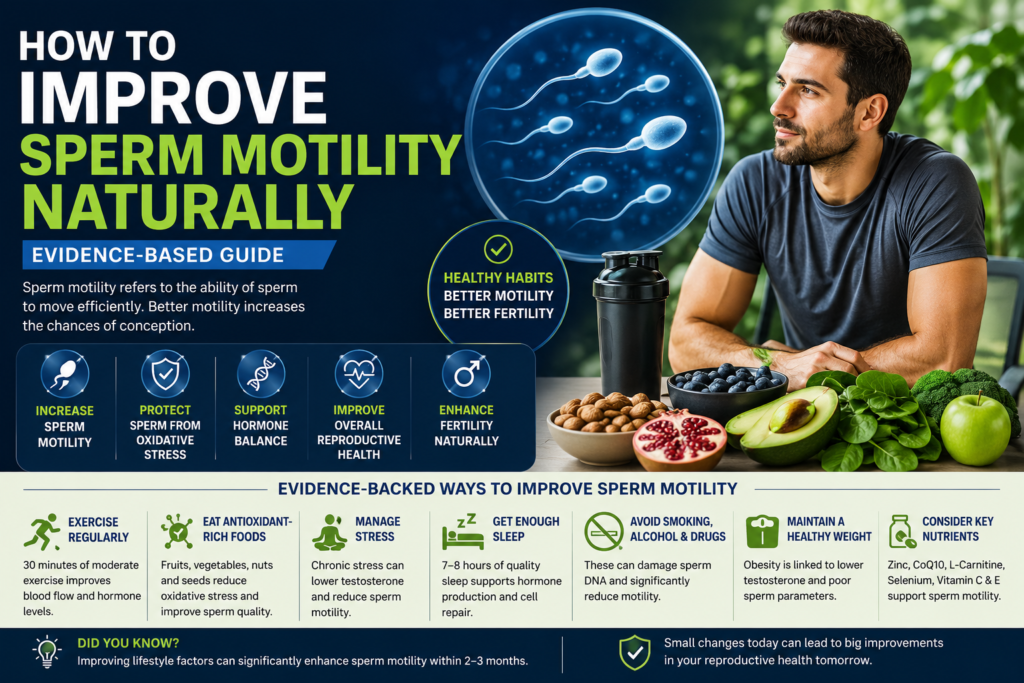
Quick answer: Maintaining a healthy weight, exercising regularly, avoiding smoking and recreational drugs, moderating alcohol, eating a nutrient-dense diet, limiting excessive testicular heat, getting adequate sleep, and addressing underlying medical problems may support sperm health. Nutrients and supplements such as zinc, selenium, CoQ10, and L-carnitine have also been studied, but evidence doesn’t support guaranteeing that any supplement will correct low sperm motility.
If sperm concentration is your primary concern instead, read our guide on how to increase sperm count naturally and our complete guide to understanding a normal sperm count.
What Is Sperm Motility?
Sperm motility describes the ability of sperm cells to move.
Movement matters because sperm released during ejaculation have a difficult journey ahead of them.
To participate in natural fertilization, sperm must travel through the female reproductive tract toward the egg.
Simply having millions of sperm in semen therefore doesn’t tell the entire story.
A man might have:
high sperm concentration + poor motility
while another might have:
lower sperm concentration + better motility.
Neither sperm count nor motility should be interpreted in isolation.
What Is Progressive Sperm Motility?
Not all movement is equally useful.
Imagine two sperm cells.
One is moving forward steadily.
Another is moving its tail but mostly traveling in circles or barely changing position.
Both technically demonstrate movement, but the first sperm is making useful forward progress.
That’s where progressive motility becomes important.
Progressive motility refers to sperm moving actively in a forward direction.
A semen analysis may therefore report both:
- total motility, and
- progressive motility.
This provides more information than simply recording whether sperm move.
What Is a Normal Sperm Motility Percentage?
Reference information associated with the World Health Organization’s 6th edition semen manual reports lower reference values of approximately:
| Parameter | Lower Reference Value |
|---|---|
| Total motility | 42% |
| Progressive motility | 30% |
These numbers require careful interpretation.
A progressive motility result of 29% doesn’t suddenly make a man infertile.
Likewise, 50% progressive motility doesn’t guarantee pregnancy.
WHO reference limits aren’t fertility pass/fail thresholds.
Professional male infertility guidance emphasizes that individual semen-analysis parameters cannot independently determine whether a man is fertile or infertile.
What Is Low Sperm Motility?
Abnormally reduced sperm motility is commonly called asthenozoospermia or asthenospermia.
However, seeing reduced motility on one semen analysis doesn’t necessarily explain why motility is impaired.
That’s the more important question.
Potential contributors include:
- varicocele;
- oxidative stress;
- infections;
- inflammation;
- genetic factors;
- testicular dysfunction;
- smoking;
- obesity;
- excessive heat;
- certain medications;
- environmental exposures;
- nutritional problems;
- and other reproductive conditions.
Sometimes the cause remains unexplained.
Can You Get Pregnant With Low Sperm Motility?
Yes.
Low sperm motility doesn’t automatically mean natural conception is impossible.
The probability depends on many variables, including:
- degree of motility impairment;
- sperm concentration;
- total motile sperm count;
- morphology;
- female reproductive health;
- age of both partners;
- timing of intercourse;
- and the underlying cause.
For example, mildly reduced motility with otherwise favorable semen parameters represents a different situation from extremely poor motility combined with a very low sperm concentration.
This is why interpreting the complete semen analysis matters.
What Is Total Motile Sperm Count?
Total motile sperm count attempts to combine several important measurements.
It considers factors such as:
semen volume × sperm concentration × proportion of motile sperm
This can sometimes provide more useful clinical context than looking at sperm concentration alone.
Consider two men with the same concentration.
Man A
40 million sperm/mL with strong motility.
Man B
40 million sperm/mL with severely impaired motility.
Looking only at the concentration would make their semen analyses appear much more similar than they really are.
Can Sperm Motility Be Improved Naturally?
Potentially, depending on the cause.
There isn’t one universal treatment because low motility isn’t one disease.
If impaired motility is associated with a modifiable factor such as smoking, obesity, poor dietary habits, or repeated excessive heat exposure, addressing that factor may support reproductive health.
But lifestyle changes cannot correct every cause.
For example, nutritional supplements aren’t going to fix every genetic abnormality or reproductive-tract condition.
The first goal should therefore be:
support overall reproductive health while determining whether an underlying medical problem needs attention.
1. Stop Smoking
Smoking is one of the most important modifiable reproductive-health exposures.
Research has associated cigarette smoking with poorer semen quality, including effects involving:
- sperm concentration;
- motility;
- morphology;
- oxidative stress;
- and sperm DNA.
Smoking introduces numerous chemicals into the body and may contribute to oxidative damage affecting sperm.
This doesn’t mean every smoker will have poor motility.
But if you’re trying to optimize fertility, eliminating tobacco exposure is a sensible place to start.
What about vaping?
Electronic cigarettes shouldn’t automatically be considered harmless to fertility.
Research into vaping and male reproductive health is still developing.
If you’re trying to conceive, reducing unnecessary nicotine and chemical exposure is more sensible than assuming a newer delivery method is completely safe.
2. Maintain a Healthy Weight
Obesity can influence male reproductive health through several mechanisms.
These may include:
- hormonal changes;
- inflammation;
- oxidative stress;
- metabolic dysfunction;
- increased scrotal temperature;
- and sexual dysfunction.
Research has associated obesity with changes in semen quality in some populations.
The solution isn’t crash dieting.
Instead, focus on gradual, sustainable improvements in:
- food quality;
- physical activity;
- sleep;
- metabolic health;
- and body composition.
These changes benefit considerably more than fertility.
3. Exercise Regularly
Regular exercise can support:
- cardiovascular health;
- insulin sensitivity;
- body composition;
- hormonal health;
- stress management;
- and general wellbeing.
These benefits may indirectly support reproductive health as well.
Moderate regular exercise is very different from extreme training.
Can too much exercise affect sperm?
Potentially.
Very high training loads combined with inadequate nutrition, poor recovery, anabolic steroid use, or chronic physical stress may negatively affect reproductive health.
The goal isn’t to exercise as much as physically possible.
It’s to exercise consistently while allowing adequate recovery.
4. Eat a Nutrient-Dense Diet
There is no single “sperm motility food.”
Instead, research tends to examine overall dietary patterns.
A balanced diet emphasizing minimally processed foods can provide nutrients involved in:
- antioxidant defense;
- cellular energy;
- hormone production;
- sperm development;
- and general metabolic health.
Useful foods may include:
- vegetables;
- fruits;
- berries;
- whole grains;
- legumes;
- nuts;
- seeds;
- eggs;
- fish;
- lean protein sources;
- olive oil;
- and other healthy fats.
Rather than searching for one miracle food, improve your overall dietary pattern.
5. Get Enough Zinc
Zinc plays an established role in male reproductive biology.
Scientific research has investigated zinc in connection with:
- sperm development;
- sperm maturation;
- motility;
- reproductive hormones;
- and fertilization.
Dietary sources include:
- oysters;
- shellfish;
- meat;
- poultry;
- dairy products;
- beans;
- nuts;
- and seeds.
This is also why zinc appears in many male fertility supplements.
For example, our Fertility Factor 5 review examines a male fertility formula containing zinc alongside Tongkat Ali, selenium, Panax ginseng, and BioPerine.
But supplementation shouldn’t be confused with “the more zinc, the better.”
Correcting inadequate intake is very different from taking excessive doses when zinc status is already sufficient.
6. Pay Attention to Selenium
Selenium is another micronutrient frequently associated with male reproductive health.
It contributes to selenoproteins involved in antioxidant defense and normal biological processes.
Research has examined selenium in relation to sperm development and motility.
Food sources include:
- seafood;
- meat;
- poultry;
- eggs;
- dairy;
- grains;
- and Brazil nuts.
However, selenium has a relatively narrow nutritional range compared with many nutrients.
Too little may be undesirable.
Too much can also be harmful.
Don’t combine several selenium-containing supplements without considering your total intake.
7. Consider Omega-3-Rich Foods
Omega-3 fatty acids are important components of cell membranes and have been investigated in relation to male reproductive health.
Fatty fish provides long-chain omega-3 fatty acids along with other nutrients.
Examples include:
- salmon;
- sardines;
- mackerel;
- herring;
- and trout.
Plant foods such as walnuts, chia seeds, and flaxseeds provide alpha-linolenic acid, another omega-3 fatty acid.
Research into omega-3 supplementation and male fertility is interesting but not strong enough to promise that taking fish-oil capsules will correct low motility.
Food quality remains a sensible starting point.
8. Limit Excessive Testicular Heat
Sperm production works best within an appropriate temperature range.
That’s one reason the testes are located outside the abdominal cavity.
Researchers have investigated repeated scrotal heat exposure in relation to semen quality.
Potential heat exposures include:
- frequent hot tubs;
- prolonged sauna sessions;
- heated seats;
- certain occupational environments;
- prolonged direct heat;
- and placing a hot laptop directly against the groin.
This doesn’t mean a single sauna session will make you infertile.
The bigger concern is repeated and sustained excessive heat exposure, particularly when semen parameters are already abnormal.
9. Moderate Heavy Alcohol Consumption
Alcohol and fertility aren’t an all-or-nothing relationship.
Heavy or chronic alcohol consumption is more concerning than occasional use.
Excessive intake may influence:
- reproductive hormones;
- testicular function;
- sexual function;
- liver health;
- and semen quality.
If you’re actively trying to optimize fertility, reducing heavy alcohol consumption is a practical step.
10. Avoid Recreational Drugs
Some recreational substances may affect reproductive health directly or indirectly.
Potential effects can involve:
- hormones;
- sperm production;
- sexual function;
- general health;
- and lifestyle behaviors.
If you’re trying to conceive, avoiding unnecessary recreational drug exposure is sensible.
11. Avoid Anabolic Steroids
Anabolic-androgenic steroids deserve special attention.
They can suppress the body’s natural reproductive hormonal signaling.
This can substantially impair sperm production.
Some steroid users may develop:
- very low sperm concentrations;
- abnormal semen parameters;
- or even azoospermia.
A man can look extremely muscular while simultaneously having severely impaired sperm production.
Physical appearance tells you nothing reliable about fertility.
12. Be Careful With Testosterone Therapy
This is one of the biggest misconceptions in male fertility.
Testosterone is essential to normal male reproductive physiology.
So it seems logical to think:
“Taking testosterone should improve sperm.”
External testosterone can actually do the opposite.
It can suppress signals from the brain and pituitary gland that are necessary for normal sperm production.
Current AUA/ASRM guidance states that testosterone monotherapy should not be prescribed to men interested in current or future fertility.
If you’re already using medically prescribed testosterone and want to conceive, don’t simply stop treatment yourself.
Discuss your fertility goals with the clinician managing your therapy.
13. Prioritize Sleep
Sleep influences:
- hormones;
- metabolic health;
- body weight;
- stress;
- cardiovascular health;
- and overall wellbeing.
Research has also investigated relationships between sleep duration, sleep quality, and male reproductive parameters.
You don’t need a special “fertility sleep schedule.”
Aim for consistent, sufficient, high-quality sleep.
If you experience:
- loud snoring;
- pauses in breathing;
- severe daytime sleepiness;
- chronic insomnia;
- or consistently poor sleep,
consider discussing it with a healthcare professional.
14. Manage Chronic Stress
Stress shouldn’t be blamed for every fertility problem.
Infertility itself can cause substantial psychological stress.
However, chronic stress can affect:
- sleep;
- libido;
- sexual performance;
- alcohol consumption;
- diet;
- physical activity;
- and overall health.
Managing stress therefore makes sense as part of a broader reproductive-health strategy.
Useful approaches can include:
- exercise;
- adequate sleep;
- mindfulness;
- relaxation techniques;
- social support;
- counseling;
- and addressing chronic work or relationship stressors.
15. Review Your Medications
Certain medications can potentially affect:
- sperm production;
- sperm function;
- reproductive hormones;
- ejaculation;
- erections;
- or libido.
This doesn’t mean you should stop prescription medication.
Instead, tell your healthcare provider that you’re trying to conceive.
Ask whether any medications you take could potentially influence fertility and whether alternatives are appropriate.
Never stop an important medication solely because you read something online.
Can Supplements Improve Sperm Motility?
This is one of the most commercially exploited areas of male fertility.
Common fertility supplements contain ingredients such as:
- CoQ10;
- L-carnitine;
- zinc;
- selenium;
- vitamin C;
- vitamin E;
- folate;
- omega-3 fatty acids;
- ashwagandha;
- Tongkat Ali;
- and other antioxidants.
Some have encouraging research.
However, there is an important distinction between:
improving a semen parameter in a study
and
demonstrating that a supplement increases pregnancy or live-birth rates.
Those are not equivalent outcomes.
The AUA/ASRM male infertility guideline remains cautious about the clinical utility of supplements such as antioxidants and vitamins because available evidence is insufficient to recommend specific agents universally.
If you’re comparing products, see our best male fertility supplements guide.
CoQ10 and Sperm Motility
Coenzyme Q10 is one of the most interesting fertility-supplement ingredients.
CoQ10 participates in mitochondrial energy production.
That’s biologically relevant because sperm movement requires energy.
CoQ10 also has antioxidant properties.
Clinical studies and systematic reviews have investigated CoQ10 supplementation in men with infertility, with some reporting improvements in semen parameters such as motility.
However, there’s still an evidence gap between:
better laboratory measurements
and
proven improvements in pregnancy or live birth.
Therefore, CoQ10 is better described as promising rather than guaranteed.
L-Carnitine and Sperm Motility
L-carnitine is another ingredient frequently found in male fertility products.
It plays a role in cellular energy metabolism and is present within the male reproductive tract.
Research has investigated L-carnitine and acetyl-L-carnitine in relation to sperm motility.
Some findings are encouraging.
But again, product formulation, dose, population, study quality, and fertility outcomes matter.
Don’t assume every supplement containing a small amount of L-carnitine will reproduce the results of every clinical study.
Zinc and Sperm Motility
Zinc is biologically important for normal reproductive function.
Research has associated zinc status with various semen parameters.
However:
zinc deficiency ≠ everyone needs high-dose zinc supplementation.
If dietary intake is adequate, taking increasingly large amounts doesn’t necessarily create increasingly healthy sperm.
Excessive zinc can also interfere with the metabolism of other minerals.
Selenium and Sperm Motility
Selenium participates in antioxidant systems and normal sperm biology.
Some fertility supplements combine selenium with other antioxidants.
This creates a plausible biological rationale.
But selenium also illustrates why more isn’t always better.
Both insufficient and excessive selenium exposure can be problematic.
Supplementation should therefore be approached thoughtfully.
Tongkat Ali and Sperm Motility
Tongkat Ali (Eurycoma longifolia) has become increasingly popular in men’s-health supplements.
Standardized extracts have been investigated for:
- testosterone;
- male reproductive health;
- libido;
- sperm concentration;
- motility;
- and other semen parameters.
Some human research involving men with idiopathic infertility has reported encouraging changes in semen parameters.
However, those results shouldn’t be generalized to every Tongkat Ali product.
Extract standardization, dosage, duration, and participant characteristics matter.
One product containing standardized Tongkat Ali is Fertility Factor 5. Our Fertility Factor 5 review examines the evidence behind its Tongkat Ali, zinc, selenium, Panax ginseng, and BioPerine formula in more detail.
Do Antioxidants Improve Sperm Motility?
Oxidative stress is an important area of male fertility research.
Reactive oxygen species aren’t inherently bad; they participate in normal sperm physiology at appropriate levels.
The problem arises when oxidative activity overwhelms antioxidant defenses.
Excessive oxidative stress may damage:
- sperm membranes;
- proteins;
- mitochondria;
- and DNA.
This provides the rationale behind antioxidant supplementation.
But biological rationale isn’t enough to prove clinical effectiveness.
Large evidence reviews have found uncertainty around whether antioxidant supplementation reliably improves the fertility outcomes that ultimately matter most.
Therefore, antioxidants shouldn’t be presented as a guaranteed cure for poor sperm motility.
What Foods May Support Sperm Motility?
Rather than creating a list of magical fertility foods, focus on dietary patterns that provide essential nutrients.
Useful options include:
Fish
Provides protein, selenium, vitamin D in some species, and omega-3 fatty acids.
Nuts
Provide healthy fats, minerals, and antioxidant compounds.
Walnuts have received particular research attention in relation to semen parameters.
Fruits
Provide vitamin C, polyphenols, and numerous other micronutrients.
Vegetables
Leafy greens, peppers, tomatoes, cruciferous vegetables, and other colorful vegetables contribute folate, antioxidants, carotenoids, and other nutrients.
Eggs
Provide protein, choline, selenium, and other nutrients.
Legumes
Beans, chickpeas, and lentils provide protein, folate, minerals, and fiber.
Whole Grains
Provide fiber, minerals, B vitamins, and other nutrients.
Olive Oil
A useful source of unsaturated fat within Mediterranean-style dietary patterns.
The broader dietary pattern matters more than eating one specific food every day.
Does Coffee Affect Sperm Motility?
Research on caffeine and male fertility isn’t completely straightforward.
Moderate coffee consumption isn’t generally considered equivalent to heavy exposure to highly caffeinated products or other unhealthy lifestyle behaviors.
If you consume extremely high quantities of caffeine, reducing intake may be sensible for general health and sleep quality.
But coffee shouldn’t automatically be blamed for every abnormal semen-analysis result.
Does Hydration Improve Sperm Motility?
Proper hydration supports normal physiological function.
However, drinking excessive quantities of water isn’t a proven treatment for low sperm motility.
Remember that semen fluid and sperm cells aren’t the same thing.
Increasing fluid intake may influence hydration status, but it doesn’t directly guarantee healthier sperm movement.
Does Ejaculation Frequency Affect Sperm Motility?
Yes, abstinence duration can influence semen-analysis parameters.
Longer abstinence may increase:
- semen volume;
- sperm concentration;
- total sperm number.
But longer isn’t automatically better.
Some research suggests shorter abstinence intervals may be associated with favorable motility or sperm DNA characteristics in certain contexts.
Therefore, don’t assume “saving sperm” for weeks will maximize fertility.
For semen testing, follow the abstinence instructions provided by the laboratory.
For conception, regular intercourse during the fertile window is generally more practical than extreme abstinence.
How Long Does It Take to Improve Sperm Motility?
Sperm aren’t produced overnight.
Spermatogenesis and subsequent maturation occur over an extended biological cycle.
Therefore, lifestyle changes made today may require weeks or months before their potential effect can be meaningfully assessed in a semen analysis.
This is why advertisements promising dramatically improved sperm quality within a few days deserve skepticism.
We’ll explore this in detail in our upcoming guide to how long it takes to improve sperm quality.
Can Sperm Motility Change Between Tests?
Absolutely.
Semen parameters vary naturally.
Motility can potentially be affected by:
- abstinence duration;
- recent illness;
- fever;
- sample collection;
- transport conditions;
- time between collection and analysis;
- medications;
- lifestyle;
- and normal biological variability.
One abnormal semen analysis doesn’t necessarily establish a permanent condition.
When clinically appropriate, repeat testing may provide a clearer picture.
Can Fever Affect Sperm Motility?
Potentially.
A significant fever can temporarily affect sperm production and semen quality.
Because sperm development takes time, changes may persist beyond the period when you actually feel sick.
If you recently experienced a significant febrile illness, tell the clinician interpreting your semen analysis.
Can Varicocele Cause Poor Sperm Motility?
Varicocele refers to enlargement of veins within the scrotum.
It is relatively common and has been associated with male infertility.
Potential mechanisms involve:
- increased scrotal temperature;
- oxidative stress;
- impaired testicular function;
- and other physiological changes.
Not every varicocele causes infertility.
And not every varicocele requires treatment.
However, if you have abnormal semen parameters and a clinically significant varicocele, professional evaluation can determine whether it may be relevant.
Does Poor Motility Mean Your Sperm Are Dead?
No.
This is another common misunderstanding.
Motility and vitality aren’t identical.
Motility asks:
Is the sperm moving?
Vitality asks:
Is the sperm alive?
A sperm cell can be alive but immotile.
When very few sperm are moving, laboratory vitality testing can sometimes help distinguish between living immotile sperm and dead sperm.
What If Sperm Motility Is Zero?
Complete absence of sperm movement requires professional evaluation.
The laboratory may perform additional testing to determine whether the sperm are alive but immotile or nonviable.
Severely impaired motility can have different causes, including rare genetic conditions.
This isn’t something to diagnose from supplement advertisements.
A male reproductive specialist can help determine what additional investigation is appropriate.
How Is Low Sperm Motility Treated?
Treatment depends on the underlying cause.
Potential approaches might involve:
- lifestyle modification;
- treating certain infections;
- addressing hormonal abnormalities;
- medication review;
- management of a clinically relevant varicocele;
- stopping gonadotoxic exposures;
- addressing anabolic steroid or testosterone use;
- correcting nutritional deficiencies;
- or assisted reproductive techniques when appropriate.
There isn’t one treatment called “the sperm motility treatment.”
That’s why identifying the cause matters.
When Should You Get Professional Help?
Consider appropriate fertility evaluation if:
- you’ve been trying unsuccessfully to conceive;
- multiple semen parameters are abnormal;
- motility is severely reduced;
- sperm concentration is very low;
- no sperm are present;
- you experience testicular pain or swelling;
- you have a known varicocele;
- you’ve used anabolic steroids;
- you’re taking testosterone;
- you’ve had chemotherapy or radiation;
- you have sexual or ejaculation difficulties;
- or you have another reproductive-health concern.
Male and female fertility factors can occur simultaneously.
AUA/ASRM guidance therefore recommends concurrent evaluation of both partners during an infertility assessment.
The Bottom Line
Sperm motility matters because sperm need to move effectively to participate in natural fertilization.
The WHO 6th edition reference information reports lower reference values around 42% for total motility and 30% for progressive motility, but these values shouldn’t be interpreted as absolute fertile/infertile thresholds.
If motility is low, don’t immediately assume you need a supplement.
Start by looking at the bigger picture:
- Don’t smoke.
- Maintain a healthy weight.
- Exercise regularly.
- Eat a nutrient-dense diet.
- Get adequate sleep.
- Reduce heavy alcohol consumption.
- Avoid anabolic steroids.
- Be careful with testosterone therapy when fertility matters.
- Limit repeated excessive testicular heat.
- Review medications with your healthcare provider.
- Investigate significant or persistent abnormalities.
Ingredients such as CoQ10, L-carnitine, zinc, selenium, and Tongkat Ali have scientific research behind them, but evidence shouldn’t be exaggerated.
Improving a semen-analysis number is not the same as proving an increased chance of pregnancy or live birth.
If your motility is substantially reduced, identifying the underlying reason is more useful than simply trying one supplement after another.
Frequently Asked Questions
What percentage of sperm motility is normal?
WHO 6th edition reference data report a lower reference value of approximately 42% for total motility and 30% for progressive motility. These aren’t absolute thresholds separating fertile from infertile men.
Can you get pregnant with 30% sperm motility?
Pregnancy may be possible with many different motility values. Motility needs to be interpreted alongside sperm concentration, semen volume, morphology, female fertility factors, age, and other variables.
What causes poor sperm motility?
Potential causes include varicocele, oxidative stress, infections, genetic factors, smoking, obesity, excessive heat, certain medications, testicular dysfunction, and other reproductive conditions.
What foods increase sperm motility?
No single food has been proven to reliably correct poor sperm motility. A nutrient-dense dietary pattern containing vegetables, fruits, nuts, legumes, whole grains, fish, healthy fats, and adequate protein is a more sensible strategy.
Does zinc increase sperm motility?
Zinc is essential for normal reproductive biology and has been studied in relation to semen parameters. However, zinc supplementation isn’t guaranteed to improve motility in men who already have adequate zinc status.
Does selenium improve sperm motility?
Selenium plays an important role in normal sperm biology and antioxidant systems. Some research is encouraging, but supplementation needs to be balanced because excessive selenium can be harmful. Also see what a normal sperm count looks like.
Does CoQ10 improve sperm motility?
Clinical research has reported improvements in certain semen parameters, including motility, with CoQ10 supplementation in some populations. Evidence for pregnancy and live-birth outcomes is less definitive.
Does L-carnitine improve sperm motility?
L-carnitine has been investigated extensively in male fertility because of its role in cellular energy metabolism. Some studies report improvements in motility, but results shouldn’t be treated as guaranteed.
Does Tongkat Ali improve sperm motility?
Standardized Tongkat Ali extracts have been studied in relation to male reproductive health and semen parameters. Research is promising but not sufficient to guarantee improved motility for every user.
Can exercise improve sperm motility?
Regular moderate exercise and healthier body composition may support reproductive health. Extreme exercise, inadequate recovery, or anabolic steroid use can have the opposite effect.
Can sperm motility improve in three months?
Because sperm production and maturation take time, changes in reproductive health are generally evaluated over weeks to months rather than days. Whether motility improves depends on the underlying cause.
Can low sperm motility be reversed?
Sometimes. Potentially reversible factors include certain lifestyle exposures, medications, nutritional problems, varicocele, and other conditions. Other causes may be more difficult to correct.
Does masturbation affect sperm motility?
Ejaculation frequency can influence semen-analysis measurements. However, masturbation doesn’t permanently damage sperm motility in otherwise healthy men.
Can heat reduce sperm motility?
Repeated or prolonged excessive scrotal heat may negatively affect semen quality. Occasional heat exposure isn’t equivalent to chronic high-temperature exposure.
Is low sperm motility the same as infertility?
No. Motility is one fertility parameter. Low motility can reduce reproductive potential, but it doesn’t independently determine whether natural conception is possible.
Related Articles on Fitness Donkey
- SemEnhance semen volume supplement
- Semenoll volume support supplement
- PrimeGENIX prostate health supplement
- Titan Transform male enhancement supplement
Scientific Sources & References
- World Health Organization — WHO Laboratory Manual for the Examination and Processing of Human Semen, 6th Edition
- American Urological Association — Diagnosis and Treatment of Infertility in Men: AUA/ASRM Guideline
- American Society for Reproductive Medicine — Diagnosis and Treatment of Infertility in Men: Guideline Part I
- NCBI/PMC — Lifestyle Causes of Male Infertility
- PubMed — Coenzyme Q10 and Male Infertility: A Meta-Analysis
- NCBI/PMC — Antioxidant Supplements and Semen Parameters: An Evidence-Based Review
- Cochrane — Antioxidants for Male Subfertility
- NCBI/PMC — Zinc Is an Essential Element for Male Fertility
Medical Disclaimer
This article is intended for informational and educational purposes only. It isn’t intended to diagnose, treat, cure, or prevent infertility or another medical condition.
Sperm motility is only one component of male fertility, and semen-analysis results require appropriate clinical context.
If you have significantly reduced sperm motility, multiple abnormal semen parameters, or persistent difficulty conceiving, consider discussing your results with a qualified healthcare professional.