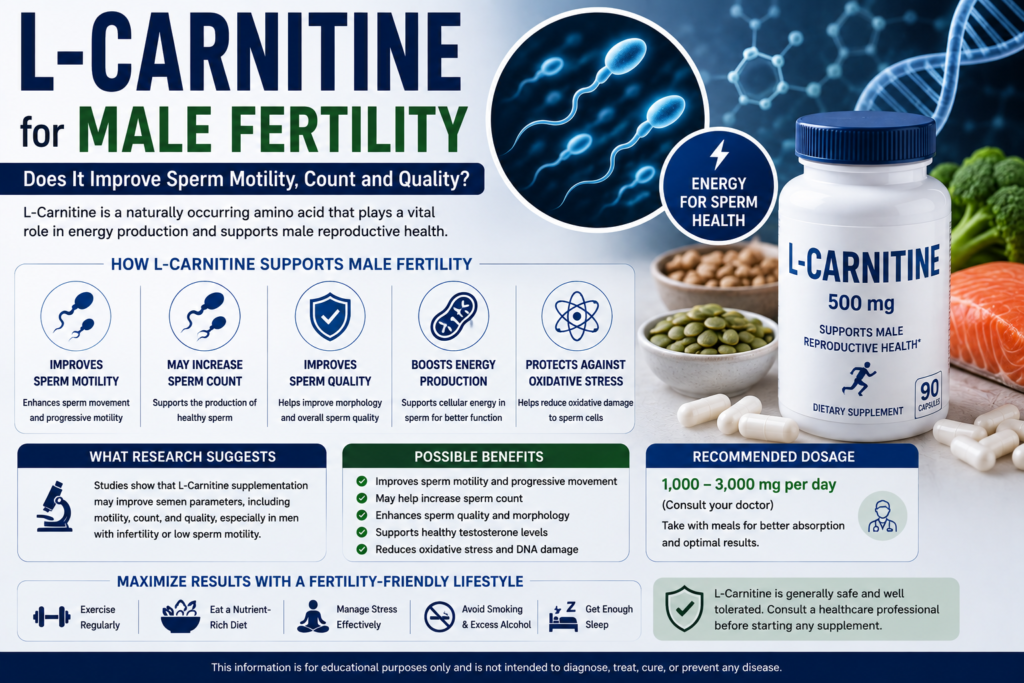
L-carnitine is one of the most widely used ingredients in male fertility supplements, particularly products designed to support sperm motility.
There’s a good biological reason for that interest.
Sperm cells require substantial amounts of energy to move. L-carnitine participates in cellular energy metabolism and is found in particularly high concentrations within the male reproductive tract, especially the epididymis—the structure where sperm mature after leaving the testes.
Researchers have therefore investigated L-carnitine and its related form, acetyl-L-carnitine (ALCAR), for male infertility, sperm motility, concentration, morphology, and pregnancy outcomes.
Some results are encouraging.
But L-carnitine isn’t a universal treatment for male infertility, and taking more doesn’t necessarily produce better sperm.
Quick answer: Clinical research suggests L-carnitine and acetyl-L-carnitine may improve sperm motility and some other semen parameters in certain men with infertility. Evidence for improvements in pregnancy and live-birth rates is considerably less certain. L-carnitine should therefore be viewed as a potentially useful fertility supplement rather than a proven treatment for infertility.
What Is L-Carnitine?
L-carnitine is a naturally occurring compound made from the amino acids lysine and methionine.
Your body produces carnitine primarily in the:
- liver;
- kidneys;
- and brain.
It is also obtained from food, particularly animal-derived foods.
Carnitine plays a major role in energy metabolism.
One of its best-known functions involves transporting long-chain fatty acids into mitochondria.
Mitochondria are often described as the powerhouses of cells because they help generate ATP—the energy cells use to perform biological work.
This connection between L-carnitine and energy production is particularly interesting when discussing sperm.
Why Is L-Carnitine Important for Sperm?
Sperm are highly specialized cells.
After sperm are produced in the testes, they aren’t immediately fully capable of effective movement and fertilization.
They undergo further maturation as they pass through the epididymis.
Carnitine concentrations are particularly high within epididymal fluid.
Research suggests carnitine is involved in:
- sperm maturation;
- energy metabolism;
- membrane stability;
- sperm movement;
- mitochondrial function;
- and protection against oxidative stress.
The concentration of free L-carnitine within the epididymis can be substantially higher than in blood.
That makes the relationship between carnitine and sperm physiology biologically compelling.
Why Does Sperm Motility Require So Much Energy?
Look at the structure of a sperm cell.
It contains:
- a head;
- midpiece;
- tail.
The midpiece contains numerous mitochondria.
These mitochondria contribute energy required for the tail to generate movement.
Sperm must then travel through the female reproductive tract toward the egg.
Poor cellular energy metabolism could theoretically interfere with efficient movement.
This helps explain why compounds involved in mitochondrial metabolism—particularly L-carnitine and CoQ10—have received substantial attention in male fertility research.
What Is Acetyl-L-Carnitine?
Acetyl-L-carnitine, commonly abbreviated ALCAR, is an acetylated form of L-carnitine.
It participates in cellular metabolism but has somewhat different biological characteristics.
Male fertility studies have investigated:
- L-carnitine alone;
- acetyl-L-carnitine alone;
- combinations of both.
This matters when reading research because a study using a combination of L-carnitine and ALCAR doesn’t necessarily prove that either ingredient alone would produce exactly the same result.
L-Carnitine vs. Acetyl-L-Carnitine for Fertility
Both have been investigated.
L-Carnitine
Has particularly strong biological relevance within the male reproductive tract and epididymis.
Acetyl-L-Carnitine
Also participates in cellular metabolism and has antioxidant-related and mitochondrial effects.
Some clinical studies have combined the two.
Therefore, it isn’t currently possible to say that one form is universally superior for male fertility.
The evidence depends on:
- dose;
- combination;
- infertility diagnosis;
- treatment duration;
- and study design.
Does L-Carnitine Improve Sperm Motility?
This is probably the strongest fertility-related argument for L-carnitine.
Multiple clinical studies have investigated carnitine supplementation in men with reduced sperm motility.
Some have reported improvements in:
- total sperm motility;
- progressive motility;
- sperm concentration;
- overall semen quality.
Systematic reviews and meta-analyses have also reported potentially favorable effects.
However, results aren’t universally consistent.
A supplement may work differently depending on why motility is poor.
For example, low motility associated with oxidative stress may represent a different biological situation from low motility caused by a severe genetic flagellar disorder.
Therefore:
L-carnitine may improve sperm motility in some infertile men, but it cannot be expected to correct every cause of asthenozoospermia.
What Is Asthenozoospermia?
Asthenozoospermia—also called asthenospermia—refers to abnormally reduced sperm motility.
Sperm may:
- move slowly;
- demonstrate poor forward progression;
- move inefficiently;
- or remain immotile.
Poor motility can have many potential causes, including:
- varicocele;
- oxidative stress;
- genetic abnormalities;
- infections;
- smoking;
- obesity;
- excessive heat;
- testicular dysfunction;
- environmental exposures;
- and unexplained factors.
L-carnitine has attracted particular research interest in men with impaired motility because of its relationship with sperm energy metabolism.
Does L-Carnitine Improve Progressive Motility?
Progressive motility is especially important.
It refers to sperm moving effectively forward rather than merely moving their tails without meaningful progression.
Several studies involving carnitine supplementation have reported improvements in progressive motility.
That’s potentially clinically relevant because forward movement is required for sperm to navigate the female reproductive tract.
However, progressive motility still needs to be considered alongside:
- sperm concentration;
- total sperm number;
- morphology;
- semen volume;
- female fertility factors.
Improving one number doesn’t guarantee conception.
Does L-Carnitine Increase Sperm Count?
Although L-carnitine is best known for motility, research has also investigated sperm concentration.
Some clinical trials and evidence reviews have reported improvements in sperm concentration after carnitine supplementation.
But evidence appears less straightforward than the biological argument surrounding motility.
A low sperm count can result from many problems that carnitine isn’t going to correct.
These include:
- testosterone therapy;
- anabolic steroids;
- genetic conditions;
- severe testicular dysfunction;
- obstruction;
- chemotherapy;
- radiation;
- hormonal disorders.
If concentration is significantly reduced, our article on what causes low sperm count in men explains why identifying the cause should come before assuming a nutritional supplement will fix it.
Does L-Carnitine Increase Total Sperm Count?
Potentially in some populations.
Remember that sperm concentration and total sperm number aren’t identical.
Sperm concentration
Measures sperm per milliliter.
Total sperm number
Considers the entire ejaculate.
For example:
20 million sperm/mL × 3 mL = approximately 60 million sperm
A study reporting improved concentration doesn’t necessarily mean every fertility parameter improved.
This is why semen-analysis results should be interpreted as a whole.
Does L-Carnitine Improve Sperm Morphology?
Some studies have investigated morphology alongside motility and concentration.
Evidence isn’t strong enough to consider L-carnitine a specific treatment for abnormal sperm morphology.
Morphology can be affected by numerous factors, including:
- genetics;
- testicular dysfunction;
- oxidative stress;
- varicocele;
- smoking;
- environmental exposures;
- illness.
A supplement cannot reasonably correct every underlying cause.
Does L-Carnitine Improve Sperm Quality?
“Sperm quality” is a broad term.
When researchers use it, they may be referring to one or more measurable parameters:
- concentration;
- total sperm number;
- motility;
- progressive motility;
- morphology;
- vitality;
- DNA integrity.
Therefore, a statement such as:
“L-carnitine improves sperm quality”
needs context.
The most promising evidence appears to involve motility, although other semen parameters have also been investigated.
L-Carnitine and Sperm Mitochondria
Mitochondrial function is particularly important to sperm movement.
L-carnitine helps transport fatty acids across the inner mitochondrial membrane, allowing them to participate in beta-oxidation and energy metabolism.
This provides one potential mechanism by which carnitine might influence sperm function.
However, sperm energy metabolism is complex.
Sperm can generate ATP through multiple metabolic pathways.
Therefore, the mechanism shouldn’t be simplified into:
more carnitine = more sperm energy = guaranteed fertility.
Human biology rarely works that linearly.
L-Carnitine and Oxidative Stress
L-carnitine has also been investigated for antioxidant-related effects.
Excessive reactive oxygen species can potentially damage sperm:
- membranes;
- mitochondria;
- proteins;
- DNA.
Carnitine may help influence mitochondrial function and cellular antioxidant defenses.
This provides another potential explanation for fertility benefits observed in some studies.
But antioxidants shouldn’t automatically be megadosed.
Reactive oxygen species also participate in normal sperm physiology.
Balance matters.
Does L-Carnitine Improve Sperm DNA Fragmentation?
Sperm DNA fragmentation has become an increasingly researched area of male infertility.
Oxidative stress is one potential contributor to DNA damage.
Some studies of carnitine-containing antioxidant interventions have investigated sperm DNA integrity.
Results are interesting but aren’t strong enough to conclude:
L-carnitine reliably fixes high sperm DNA fragmentation.
That’s too strong.
Sperm DNA damage can be associated with factors including:
- oxidative stress;
- smoking;
- varicocele;
- age;
- infection;
- environmental exposure;
- and other reproductive conditions.
Identifying modifiable causes remains important.
Can L-Carnitine Improve Male Fertility?
Potentially.
But “fertility” needs to be separated from “semen parameters.”
Clinical studies may report improvements in:
- sperm motility;
- concentration;
- morphology.
Those outcomes are useful.
But the ultimate fertility outcomes are:
- conception;
- pregnancy;
- live birth.
Evidence for those outcomes is considerably more limited.
Therefore, L-carnitine is better described as a potentially useful adjunct for certain semen abnormalities than as a proven fertility treatment.
Does L-Carnitine Increase Pregnancy Rates?
Some fertility studies involving carnitine have reported pregnancy outcomes.
However, the available evidence isn’t strong enough to conclude that L-carnitine reliably increases spontaneous pregnancy rates.
Pregnancy depends on both partners.
Factors include:
- female age;
- ovulation;
- ovarian reserve;
- fallopian-tube health;
- sperm quality;
- intercourse timing;
- reproductive anatomy.
Even a substantial improvement in motility doesn’t guarantee pregnancy.
Does L-Carnitine Increase Live-Birth Rates?
Evidence is even less certain for live birth.
Many supplement trials simply aren’t large enough or designed long enough to establish meaningful differences in live-birth rates.
This is an important limitation throughout male fertility supplement research.
A supplement can improve a laboratory number without necessarily improving the outcome couples care about most.
How Much L-Carnitine Is Used for Male Fertility?
There is no universally established fertility dose.
Clinical studies have used different protocols.
Common research amounts may include approximately:
1,000–3,000 mg of L-carnitine per day
depending on the study.
Some trials combine L-carnitine with acetyl-L-carnitine.
For example, researchers have used combinations involving roughly:
2 grams of L-carnitine + 1 gram of acetyl-L-carnitine per day
in selected fertility studies.
This does not mean this dose is appropriate for everyone.
Study protocols aren’t personalized medical prescriptions.
Is 500 mg of L-Carnitine Enough for Fertility?
Many commercial fertility supplements contain several hundred milligrams.
But clinical fertility research often uses larger quantities.
That creates an important issue when evaluating supplement labels.
A product can advertise:
“Contains clinically researched L-carnitine”
without necessarily containing an amount similar to that used in the research.
Always compare the actual dose.
Is 1,000 mg of L-Carnitine Good for Sperm?
One gram per day falls within the broader range used in some research and supplements.
But there isn’t a universal threshold where 1,000 mg suddenly becomes effective.
Response may depend on:
- diagnosis;
- baseline carnitine status;
- formulation;
- duration;
- other ingredients;
- individual biology.
Is 2,000 mg of L-Carnitine Good for Sperm Motility?
Two grams per day has been used in male fertility research.
That makes it a research-relevant dose.
But this shouldn’t be interpreted as a recommendation for every man trying to conceive.
Higher doses can also increase the likelihood of gastrointestinal side effects.
Is 3,000 mg of L-Carnitine Too Much?
Some studies and medical applications have used doses around this level.
However, higher intake isn’t automatically more effective.
If you’re considering several grams daily for fertility, discussing the plan with a healthcare professional is sensible, particularly if you take medications or have medical conditions.
How Long Does L-Carnitine Take to Improve Sperm?
Sperm production takes time.
Human spermatogenesis takes roughly 74 days, followed by additional maturation within the epididymis.
This is especially relevant to carnitine because the epididymis is one of the reproductive structures where carnitine concentrations are particularly high.
Therefore, fertility interventions are commonly evaluated over:
three to six months
rather than several days.
Don’t expect noticeable semen-analysis changes after taking L-carnitine for a week.
Can L-Carnitine Improve Sperm in Three Months?
Potentially.
Three months provides enough time for a meaningful portion of the sperm-production and maturation cycle.
Many male fertility studies therefore use treatment periods around this length or longer.
But improvement isn’t guaranteed.
Results depend on the underlying fertility problem.
Is Six Months Better Than Three Months?
Some studies have used six-month supplementation periods.
Longer exposure may allow researchers to observe changes over multiple sperm-production cycles.
But this doesn’t mean everyone should take L-carnitine indefinitely.
If significant abnormalities remain after several months, appropriate fertility evaluation may be more useful than simply continuing supplements.
When Should You Take L-Carnitine?
There isn’t a universally established fertility-specific time of day.
Depending on the dose, some people divide intake between multiple servings.
For example:
morning + afternoon
may be easier to tolerate than taking a large amount at once.
Follow the directions for the specific supplement you’re using.
Should L-Carnitine Be Taken With Food?
L-carnitine can generally be consumed with or without food.
Taking it with food may improve gastrointestinal tolerance for some people.
If it causes nausea or stomach discomfort on an empty stomach, taking it with a meal may be preferable.
What Foods Contain L-Carnitine?
Carnitine is particularly abundant in animal foods.
Good sources include:
Beef
Red meat is one of the richest dietary sources.
Lamb
Lamb can also provide substantial carnitine.
Pork
Contains meaningful amounts.
Fish
Several fish species provide carnitine.
Chicken
Provides smaller quantities than red meat.
Milk and Dairy Products
Dairy contributes carnitine.
Plant foods generally contain much smaller amounts.
However, the body can also synthesize carnitine.
Do Vegetarians Have Low Carnitine?
People eating vegetarian or vegan diets generally consume much less preformed carnitine than people eating meat.
However, the human body can synthesize carnitine from amino acids.
Therefore, being vegetarian doesn’t automatically mean you are carnitine deficient or infertile.
The body can also adapt to differences in dietary intake.
Fertility shouldn’t be judged solely on meat consumption.
L-Carnitine vs. CoQ10 for Sperm Motility
This is one of the most useful comparisons.
Both are associated with cellular energy metabolism.
L-Carnitine
Helps transport long-chain fatty acids into mitochondria for energy metabolism.
CoQ10
Participates in the mitochondrial electron transport chain and antioxidant defense.
Both have been studied for sperm motility.
CoQ10 has a substantial body of fertility research, while L-carnitine also has considerable evidence—particularly regarding motility.
There isn’t enough evidence to say one is universally superior.
Can You Take L-Carnitine and CoQ10 Together?
Yes, these ingredients are commonly combined in male fertility formulas.
Their biological functions are complementary rather than identical.
However:
complementary mechanisms don’t automatically guarantee additive clinical benefits.
The combination still needs appropriate evidence.
Also consider the actual dose of each ingredient.
A product containing tiny amounts of ten different ingredients may be less compelling than a simpler formula using research-relevant doses.
L-Carnitine vs. Zinc for Male Fertility
Zinc is an essential mineral.
L-carnitine is a naturally occurring compound involved primarily in energy metabolism.
Zinc may influence:
- sperm development;
- reproductive enzymes;
- DNA synthesis;
- sperm maturation;
- hormonal function.
L-Carnitine may influence:
- sperm energy metabolism;
- epididymal maturation;
- mitochondrial function;
- motility.
Neither should automatically be considered better.
Read our guide on zinc for male fertility for the complete evidence.
L-Carnitine vs. Selenium
Selenium is an essential trace mineral incorporated into selenoproteins.
These proteins participate in:
- antioxidant defense;
- sperm structure;
- reproductive biology.
L-carnitine is more closely associated with cellular energy metabolism and epididymal sperm maturation.
Both are commonly included in fertility supplements.
Our selenium for male fertility article explains why selenium dosage requires particular attention.
L-Carnitine vs. Tongkat Ali
These ingredients target very different areas.
L-Carnitine
Has stronger research relevance to:
- sperm motility;
- mitochondrial metabolism;
- sperm maturation.
Tongkat Ali
Has more research attention involving:
- testosterone;
- libido;
- male reproductive health;
- semen parameters.
Neither is automatically better.
If the primary problem is poor motility, L-carnitine has an especially plausible mechanism.
If you’re interested in hormonal and fertility research around Eurycoma longifolia, read our guide on Tongkat Ali for male fertility.
L-Carnitine vs. Ashwagandha
Ashwagandha is an herbal extract investigated for:
- stress;
- testosterone;
- male reproductive health;
- semen parameters.
L-carnitine is different because it has a direct established role in cellular energy metabolism and occurs naturally at high concentrations in the male reproductive tract.
Both have fertility research.
Neither is a proven cure for infertility.
L-Carnitine and Male Fertility Supplements
L-carnitine is a logical ingredient for fertility formulas targeting sperm motility.
However, always check the dose.
Imagine two supplements.
Supplement A
Contains 2,000 mg L-carnitine.
Supplement B
Contains 100 mg L-carnitine as part of a large proprietary blend.
Both can advertise:
“Contains L-carnitine for sperm health.”
But they’re not equivalent formulations.
Ingredient presence isn’t enough.
Dosage matters.
For product comparisons, read 5 Best Male Fertility Supplements to Increase Sperm Count, Motility & Ejaculate Volume.
Can L-Carnitine Increase Testosterone?
L-carnitine isn’t primarily considered a testosterone booster.
Some research involving specific carnitine compounds has investigated androgen signaling and exercise physiology.
However, evidence doesn’t establish conventional L-carnitine supplementation as a reliable treatment for low testosterone.
If testosterone is genuinely low, potential causes should be investigated.
These may include:
- obesity;
- pituitary disorders;
- testicular dysfunction;
- sleep disorders;
- medications;
- chronic illness;
- age-related changes.
Does L-Carnitine Improve Libido?
L-carnitine isn’t an established libido-enhancing treatment.
Sexual desire is influenced by:
- testosterone;
- stress;
- sleep;
- psychological health;
- medications;
- relationship factors;
- general health.
Improving cellular energy metabolism shouldn’t automatically be interpreted as increased libido.
Does L-Carnitine Increase Semen Volume?
There isn’t strong evidence that L-carnitine reliably increases ejaculate volume.
Remember:
sperm cells ≠ seminal fluid.
Most semen volume comes from secretions produced by reproductive glands such as the seminal vesicles and prostate.
L-carnitine research is more relevant to sperm function than the physical quantity of ejaculate.
For products marketed specifically for semen volume, see Semenoll review.
Does L-Carnitine Make Semen Thicker?
There isn’t reliable evidence that L-carnitine predictably makes semen thicker.
And semen thickness isn’t a fertility test.
You cannot accurately determine:
- sperm concentration;
- motility;
- morphology;
by looking at semen.
Laboratory semen analysis is required.
Can L-Carnitine Help Erectile Dysfunction?
L-carnitine isn’t considered a standard first-line treatment for erectile dysfunction.
Some research has investigated carnitine-containing treatments in particular patient populations.
However, persistent ED can be associated with:
- cardiovascular disease;
- diabetes;
- hypertension;
- hormonal disorders;
- medications;
- neurological problems;
- psychological factors.
Therefore, erectile dysfunction shouldn’t simply be self-treated with fertility supplements.
Is L-Carnitine Safe?
L-carnitine is generally well tolerated at commonly studied amounts.
Possible side effects include:
- nausea;
- vomiting;
- abdominal cramps;
- diarrhea;
- gastrointestinal discomfort;
- fishy body odor.
Higher doses may increase the likelihood of gastrointestinal symptoms.
Why Can L-Carnitine Cause a Fishy Smell?
Carnitine can be metabolized by intestinal bacteria into compounds including trimethylamine.
Trimethylamine has a characteristic fishy odor.
Some people taking larger doses of carnitine may therefore notice changes in:
- body odor;
- breath;
- urine.
This isn’t necessarily dangerous, but it can be unpleasant.
What Is TMAO?
Gut bacteria can metabolize dietary compounds including carnitine into trimethylamine.
The liver can then convert trimethylamine into:
trimethylamine N-oxide (TMAO).
Higher blood TMAO concentrations have been associated with cardiovascular disease in observational research.
However, the relationship is complex.
TMAO is influenced by:
- diet;
- kidney function;
- gut microbiome;
- metabolic health;
- and other factors.
It’s not scientifically appropriate to conclude simply that:
L-carnitine supplements cause heart disease.
But TMAO remains an active area of research.
Can L-Carnitine Interact With Medications?
Potential interactions should be considered.
People taking:
- anticoagulant medications;
- thyroid medications;
- seizure medications;
or managing significant chronic disease should discuss supplementation with an appropriate healthcare professional.
High-dose supplementation deserves more caution than ordinary dietary intake.
Who Should Be Careful With L-Carnitine?
Extra caution may be appropriate for people who:
- have seizure disorders;
- have significant kidney disease;
- take warfarin;
- use thyroid hormone replacement;
- take multiple medications;
- are undergoing fertility treatment;
- or consume several supplements simultaneously.
Individual medical circumstances matter.
How to Choose an L-Carnitine Supplement
Look beyond the front label.
Consider:
- L-carnitine amount per serving;
- whether ALCAR is included;
- total daily serving size;
- transparent labeling;
- manufacturer reputation;
- third-party quality testing;
- unnecessary proprietary blends;
- realistic claims.
Be skeptical of supplements promising:
- guaranteed pregnancy;
- instant motility improvements;
- complete infertility reversal;
- dramatically increased semen volume overnight.
Those claims aren’t supported by current evidence.
Should Men Trying to Conceive Take L-Carnitine?
L-carnitine is one of the more scientifically interesting fertility supplements, especially for sperm motility.
But it shouldn’t replace basic fertility care.
Start with:
- avoiding smoking;
- avoiding anabolic steroids;
- discussing testosterone therapy if you’re trying to conceive;
- moderating heavy alcohol intake;
- maintaining a healthy weight;
- exercising regularly;
- eating a nutrient-dense diet;
- sleeping adequately;
- reducing unnecessary prolonged testicular heat;
- and addressing underlying medical conditions.
Supplements work best as potential additions to a sensible strategy—not substitutes for one.
What If L-Carnitine Doesn’t Improve Sperm Motility?
Don’t automatically double your dose.
Poor motility may have another cause.
Potential explanations include:
- varicocele;
- genetic disorders;
- testicular dysfunction;
- infection;
- oxidative stress;
- smoking;
- medications;
- environmental exposure.
Persistent abnormalities should be properly investigated.
Can L-Carnitine Fix Infertility?
No supplement should be presented this way.
Male infertility isn’t one condition.
Consider a man whose infertility results from:
a reproductive-tract obstruction.
L-carnitine isn’t going to remove that obstruction.
Or someone with:
severe suppression of sperm production from testosterone therapy.
The underlying hormonal suppression needs to be addressed.
Or someone with:
a significant genetic abnormality.
More carnitine isn’t going to alter the chromosome.
This illustrates why diagnosing the cause matters.
When Should You See a Fertility Specialist?
Consider professional evaluation if:
- you’ve been trying unsuccessfully to conceive;
- sperm concentration is severely reduced;
- motility is substantially impaired;
- several semen parameters are abnormal;
- no sperm are detected;
- you have testicular pain or swelling;
- you’re using testosterone;
- you’ve used anabolic steroids;
- you’ve received chemotherapy or radiation;
- you have known hormonal abnormalities;
- or you have another significant reproductive concern.
A supplement shouldn’t delay diagnosis of a treatable fertility problem.
The Bottom Line
L-carnitine has a particularly interesting relationship with male fertility.
It is naturally concentrated within the male reproductive tract and participates in cellular energy metabolism—two characteristics directly relevant to sperm maturation and movement.
Clinical studies suggest L-carnitine, acetyl-L-carnitine, or combinations of the two may improve certain semen parameters, particularly:
- sperm motility;
- progressive motility;
- and potentially sperm concentration.
That makes L-carnitine one of the more evidence-supported ingredients worth investigating within the male fertility supplement category.
But there’s still an important limitation:
improving sperm motility doesn’t automatically mean increasing pregnancy or live-birth rates.
And L-carnitine cannot correct every medical, genetic, hormonal, or anatomical cause of infertility.
If semen parameters are substantially abnormal, identify the underlying problem first.
Then consider lifestyle, medical treatment, and evidence-based supplementation as appropriate.
Frequently Asked Questions
Is L-carnitine good for male fertility?
Clinical research suggests L-carnitine may improve certain semen parameters in some infertile men, particularly sperm motility.
Does L-carnitine increase sperm motility?
Several studies and evidence reviews have reported improvements in sperm motility following carnitine supplementation. Results aren’t universal.
Does L-carnitine increase sperm count?
Some research reports improvements in sperm concentration, although evidence is generally more compelling around motility.
Does L-carnitine improve progressive motility?
Some clinical studies have reported improvements in progressive sperm movement following L-carnitine or L-carnitine plus acetyl-L-carnitine supplementation.
Does L-carnitine improve sperm morphology?
Evidence for morphology is less consistent, and L-carnitine shouldn’t be considered a specific treatment for abnormal morphology.
What is the best L-carnitine for sperm?
Both L-carnitine and acetyl-L-carnitine have been studied. Some trials use them together. There isn’t sufficient evidence to identify one universally superior form.
How much L-carnitine should men take for fertility?
Clinical studies have used different protocols, often approximately 1–3 grams daily, sometimes combined with acetyl-L-carnitine. There is no universally established fertility dose.
Is 2,000 mg of L-carnitine good for sperm?
Two grams daily has been used in male fertility research, but research doses shouldn’t automatically be treated as personalized recommendations.
How long does L-carnitine take to improve sperm?
Because sperm production and maturation take several months, fertility studies commonly evaluate L-carnitine over approximately three to six months.
Can L-carnitine improve sperm in three months?
Potentially, depending on the underlying problem. Three months covers a meaningful portion of sperm production and maturation.
Can I take L-carnitine and CoQ10 together?
They are commonly combined in fertility formulas and affect different aspects of mitochondrial metabolism. Evidence doesn’t guarantee that combining them will produce greater fertility benefits.
Can I take L-carnitine with zinc?
Yes, they appear together in many fertility supplements. Total zinc intake should remain appropriate.
Can I take L-carnitine with selenium?
They can be combined, but total selenium intake should be monitored because excessive selenium can be harmful.
Is L-carnitine better than CoQ10 for sperm?
Both have research involving sperm motility and mitochondrial function. Evidence doesn’t establish one as universally superior.
Does L-carnitine increase testosterone?
L-carnitine isn’t established as a reliable testosterone-boosting treatment.
Does L-carnitine increase semen volume?
There isn’t strong evidence that L-carnitine reliably increases ejaculate volume.
Can L-carnitine cause a fishy smell?
Yes. Carnitine metabolism can produce trimethylamine, which may cause a fishy body odor in some people, particularly at higher supplemental doses.
Related Articles on Fitness Donkey
Scientific Sources & References
National Institutes of Health, Office of Dietary Supplements. (n.d.).
Carnitine: Fact sheet for health professionals
.
National Institutes of Health.
National Center for Biotechnology Information. (2023).
L-carnitine and male fertility: Is supplementation beneficial?
.
PubMed Central.
National Library of Medicine. (2007).
Effect of L-carnitine and/or L-acetyl-carnitine in the nutritional treatment of male infertility
.
PubMed.
National Library of Medicine. (2021).
Research on L-carnitine and L-acetyl-carnitine therapy in men with idiopathic asthenozoospermia
.
PubMed.
Cochrane. (n.d.).
Antioxidants for male subfertility
.
Cochrane Library.
American Urological Association, & American Society for Reproductive Medicine. (2024).
Diagnosis and treatment of infertility in men: AUA/ASRM guideline
.
American Urological Association.
American Society for Reproductive Medicine. (2020).
Diagnosis and treatment of infertility in men: AUA/ASRM guideline, Part I
.
World Health Organization. (2021).
WHO laboratory manual for the examination and processing of human semen (6th ed.)
.
World Health Organization.
Medical Disclaimer
This article is intended for informational and educational purposes only. It isn’t intended to diagnose, treat, cure, or prevent infertility or another medical condition.
L-carnitine supplements can differ considerably in form, dosage, purity, and formulation. They may also interact with medications or be inappropriate for certain medical conditions.
If you have substantially abnormal semen-analysis results, take prescription medications, or have persistent difficulty conceiving, discuss fertility evaluation and supplementation with an appropriately qualified healthcare professional.