A low sperm count can be frustrating, especially when you’re trying to conceive and don’t know what’s causing it.
The important thing to understand is that low sperm count isn’t one disease with one treatment.
Sperm production depends on the testes, hormones, reproductive tract, genetics, overall health, medications, lifestyle, and environmental factors. A problem anywhere along this pathway can potentially affect how many sperm appear in an ejaculate.
Some causes may be reversible. Others require medical treatment or specialist fertility care.
This guide explains the major causes of low sperm count, which lifestyle factors may contribute, what tests can help identify the cause, and what you can do next.
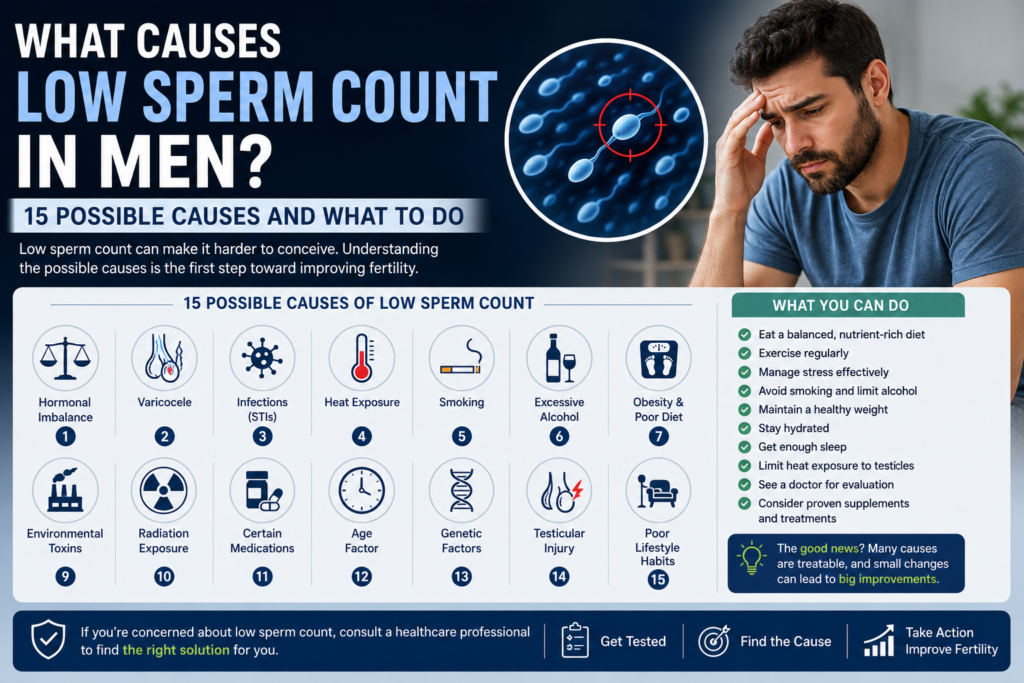
Quick answer: Low sperm count can be associated with varicocele, hormonal disorders, genetic conditions, infections, testicular injury, certain medications, testosterone therapy, anabolic steroids, obesity, smoking, heavy alcohol use, excessive heat exposure, cancer treatment, and other medical or lifestyle factors. Sometimes, no specific cause is identified.
If you’ve already received a semen analysis, start with our guide to what is a normal sperm count to understand how sperm concentration differs from total sperm number, motility, morphology, and semen volume.
What Is Considered a Low Sperm Count?
Sperm concentration refers to the number of sperm cells present in each milliliter of semen.
Reference data associated with the World Health Organization’s 6th edition semen laboratory manual report a lower reference value of approximately:
16 million sperm per milliliter
for sperm concentration.
The lower reference value for total sperm number is approximately:
39 million sperm per ejaculate.
However, these values aren’t strict boundaries between fertility and infertility.
A sperm concentration below 16 million/mL doesn’t mean natural conception is impossible.
Likewise, being above that value doesn’t guarantee fertility.
Male fertility depends on multiple factors, including:
- sperm concentration;
- total sperm number;
- progressive motility;
- total motility;
- morphology;
- semen volume;
- reproductive anatomy;
- hormonal function;
- and partner-related fertility factors.
If movement rather than concentration is your primary concern, read our guide on how to improve sperm motility naturally.
What Is Low Sperm Count Called?
The medical term commonly used for low sperm concentration is oligozoospermia, sometimes called oligospermia.
The severity can vary considerably.
A mildly reduced concentration is very different from having extremely few sperm.
When no sperm are detected in the ejaculate, the condition is called:
azoospermia.
Azoospermia requires appropriate medical evaluation because it can have obstructive, hormonal, genetic, testicular, or other causes.
Can Low Sperm Count Be Temporary?
Yes.
An abnormal sperm count isn’t necessarily permanent.
Sperm production can potentially be affected temporarily by factors such as:
- significant fever;
- acute illness;
- medications;
- heat exposure;
- lifestyle changes;
- hormonal disruption;
- and certain environmental exposures.
Semen parameters also vary naturally between samples.
This is one reason clinicians may recommend repeating an abnormal semen analysis.
However, persistent or severely abnormal results shouldn’t simply be assumed to be temporary.
They deserve appropriate evaluation.
1. Varicocele
Varicocele is one of the best-known conditions associated with male infertility.
A varicocele occurs when veins within the scrotum become enlarged.
You can think of it somewhat like varicose veins occurring around the testicle.
Varicoceles are relatively common and don’t cause infertility in every man.
However, they have been associated with impaired testicular function and abnormal semen parameters in some men.
Potential mechanisms include:
- increased scrotal temperature;
- oxidative stress;
- altered testicular blood flow;
- and impaired testicular function.
Does every varicocele need treatment?
No.
A varicocele found incidentally in a fertile man isn’t automatically a problem requiring treatment.
Clinical decisions can depend on factors such as:
- whether the varicocele is palpable;
- semen-analysis abnormalities;
- fertility history;
- symptoms;
- and the fertility status of the couple.
A reproductive urologist can determine whether a varicocele is likely to be clinically relevant.
2. Hormonal Problems
Sperm production is controlled by a complex hormonal system.
The process involves communication between the:
hypothalamus → pituitary gland → testes
Important hormones include:
- gonadotropin-releasing hormone;
- luteinizing hormone;
- follicle-stimulating hormone;
- testosterone.
Disruption anywhere along this pathway can potentially impair sperm production.
Hormonal problems may involve:
- pituitary disorders;
- hypothalamic disorders;
- abnormal testosterone production;
- elevated prolactin;
- thyroid-related problems;
- or other endocrine conditions.
This is why men with significantly abnormal sperm counts may undergo hormone testing.
3. Testosterone Therapy
This deserves its own section because it is one of the most misunderstood causes of reduced sperm production.
Testosterone is essential for male reproductive function.
But taking external testosterone isn’t the same as maintaining normal testosterone production inside the testes.
Testosterone therapy can suppress the brain’s release of hormones that stimulate the testes.
As a result, sperm production can fall substantially.
In some men, it may fall to extremely low levels.
AUA/ASRM guidance specifically advises against testosterone monotherapy for men interested in current or future fertility.
What if you’re already taking testosterone?
Don’t suddenly discontinue prescribed treatment yourself.
Tell the clinician managing your therapy that fertility is important to you.
There may be alternative approaches depending on your medical circumstances.
4. Anabolic Steroid Use
Anabolic-androgenic steroids can also suppress natural reproductive hormonal signaling.
This can result in:
- reduced intratesticular testosterone;
- lower sperm production;
- testicular shrinkage;
- severely reduced sperm concentration;
- or azoospermia.
This creates an unusual situation where someone may appear extremely muscular while having severely impaired fertility.
Muscle size is not a measure of reproductive health.
Does sperm count recover after steroids?
Recovery can occur in many men after discontinuation, but the timeframe varies.
It may take months or longer, and recovery isn’t identical for everyone.
Men with fertility concerns following anabolic steroid use should consider evaluation by a reproductive specialist.
5. Genetic Conditions
Some cases of severe male infertility have an underlying genetic cause.
Examples can include:
- Klinefelter syndrome;
- Y-chromosome microdeletions;
- CFTR gene mutations in certain obstructive conditions;
- and other chromosomal or genetic abnormalities.
Genetic causes become particularly important when sperm concentration is extremely low or no sperm are present.
Professional guidelines recommend genetic testing in selected men based on clinical circumstances.
This isn’t something that can be corrected by increasing zinc intake or buying another fertility supplement.
6. Testicular Injury
The testes are responsible for sperm production.
Damage to testicular tissue can therefore affect fertility.
Potential causes include:
- significant trauma;
- testicular torsion;
- surgery;
- infection;
- cancer;
- radiation;
- chemotherapy;
- or other testicular conditions.
The reproductive effect depends on factors such as the severity of damage and whether one or both testes are affected.
A history of major testicular injury is important information to share during a fertility evaluation.
7. Infections
Certain infections can potentially affect male fertility.
They may interfere through:
- inflammation;
- damage to reproductive tissues;
- obstruction;
- effects on sperm production;
- or changes within seminal fluid.
Sexually transmitted infections may also be relevant in some cases.
However, don’t assume every low sperm count is caused by an infection.
Testing and treatment should be based on appropriate clinical evaluation rather than taking antibiotics “just in case.”
8. Previous Cancer Treatment
Chemotherapy and radiation can affect sperm production.
The degree of reproductive impact depends on:
- treatment type;
- medication;
- dose;
- radiation location;
- age;
- baseline fertility;
- and individual susceptibility.
Some men recover sperm production after treatment.
Others may experience long-term impairment.
For men who haven’t yet undergone cancer treatment, fertility preservation such as sperm banking may sometimes be discussed before therapy begins.
Anyone with a history of cancer treatment and fertility concerns should discuss this history with a qualified clinician.
9. Obesity
Body weight can influence reproductive health through multiple pathways.
Obesity has been associated with:
- altered reproductive hormones;
- reduced testosterone;
- inflammation;
- oxidative stress;
- metabolic dysfunction;
- increased scrotal temperature;
- erectile dysfunction;
- and changes in semen parameters.
Not every man with obesity has a low sperm count.
And not every lean man has healthy sperm.
But when excess body weight is present alongside fertility problems, gradual improvement in metabolic health and body composition may be beneficial.
Our guide on how to increase sperm count naturally discusses lifestyle strategies in greater detail.
10. Smoking
Cigarette smoking has repeatedly been associated with poorer semen quality.
Research has linked smoking with potential changes involving:
- sperm concentration;
- total sperm number;
- motility;
- morphology;
- oxidative stress;
- and sperm DNA.
The relationship can vary by exposure level and individual susceptibility.
Smoking isn’t guaranteed to cause infertility.
But it is a modifiable risk factor with well-established health consequences.
If you’re trying to conceive, quitting is one of the most worthwhile changes you can make for overall health.
11. Heavy Alcohol Consumption
Alcohol’s relationship with male fertility depends partly on dose and drinking pattern.
Heavy or chronic alcohol consumption is more concerning than occasional consumption.
Excessive drinking may negatively affect:
- testosterone;
- reproductive hormones;
- testicular function;
- sexual function;
- liver health;
- and semen quality.
Reducing heavy alcohol consumption may therefore be appropriate when trying to optimize reproductive health.
12. Excessive Testicular Heat
Sperm production is temperature-sensitive.
The testes normally remain somewhat cooler than core body temperature.
Repeated or prolonged exposure to excessive heat may potentially interfere with sperm production.
Possible sources include:
- frequent hot tubs;
- repeated long sauna sessions;
- occupational heat;
- heated seats;
- prolonged direct heating;
- and placing hot devices directly against the groin.
This doesn’t mean a hot shower will suddenly destroy your sperm count.
The concern is more about repeated, prolonged, or substantial heat exposure.
Men with abnormal semen parameters may reasonably reduce unnecessary testicular heat exposure while undergoing evaluation.
13. Certain Medications
Some medications can potentially interfere with male reproductive function.
Depending on the medication, effects may involve:
- sperm production;
- reproductive hormones;
- ejaculation;
- erections;
- libido;
- or sperm transport.
Examples of drug categories that may be relevant in certain circumstances include:
- testosterone products;
- anabolic agents;
- some cancer treatments;
- certain hormonal medications;
- and other specific drugs.
The key point is:
Never stop a prescribed medication because you think it might affect sperm count.
Instead, tell your healthcare provider you’re trying to conceive and ask whether your medications could influence fertility.
Sometimes alternatives may exist.
Sometimes the medication is medically necessary and should not be changed.
14. Environmental and Occupational Exposures
Male fertility research has investigated a range of environmental exposures.
These include certain:
- pesticides;
- solvents;
- heavy metals;
- industrial chemicals;
- endocrine-disrupting compounds;
- radiation;
- and occupational heat exposures.
The real-world effect depends on:
- type of substance;
- dose;
- duration;
- route of exposure;
- protective equipment;
- and individual susceptibility.
If your occupation involves regular exposure to chemicals, metals, radiation, or substantial heat, mention this during a fertility evaluation.
15. Idiopathic Male Infertility
Sometimes doctors don’t find a clear explanation.
This may be described as idiopathic male infertility.
That doesn’t mean the problem isn’t real.
It means currently available testing hasn’t identified a specific cause.
Researchers continue to investigate potential contributors involving:
- oxidative stress;
- genetics;
- environmental factors;
- sperm DNA;
- epigenetics;
- metabolism;
- and other biological mechanisms.
This uncertainty is one reason male fertility remains an active area of medical research.
Can Stress Cause Low Sperm Count?
Possibly, but stress shouldn’t automatically be blamed.
Chronic stress may influence:
- hormonal regulation;
- sleep;
- sexual function;
- diet;
- alcohol consumption;
- exercise;
- and general health.
Research has found associations between psychological stress and semen parameters in some populations.
However, fertility is complex.
Telling a man to “relax and your sperm count will increase” isn’t evidence-based medical advice.
Stress management is better viewed as one component of overall health.
Can Lack of Sleep Lower Sperm Count?
Sleep is increasingly being studied in relation to male reproductive health.
Poor sleep can influence:
- testosterone;
- metabolic health;
- obesity risk;
- stress;
- cardiovascular health;
- and hormonal function.
Observational studies have reported associations between abnormal sleep patterns and semen quality.
However, sleep duration isn’t a magic fertility switch.
Aim for adequate, consistent sleep because it supports overall health—not because sleeping one extra hour guarantees millions of additional sperm.
Can Diet Cause Low Sperm Count?
Diet can influence reproductive health, particularly through nutritional status and metabolic health.
Dietary patterns dominated by:
- highly processed foods;
- excess calories;
- poor nutrient density;
- and inadequate fruits and vegetables
may contribute indirectly through obesity, inflammation, and poor metabolic health.
In contrast, healthier dietary patterns commonly include:
- vegetables;
- fruits;
- nuts;
- seeds;
- whole grains;
- legumes;
- fish;
- eggs;
- lean proteins;
- and healthy fats.
No individual food determines your sperm count.
Overall dietary quality matters more.
Can Vitamin Deficiencies Affect Sperm Production?
Normal sperm production depends on adequate nutrition.
Researchers have investigated several nutrients in male fertility, including:
- zinc;
- selenium;
- folate;
- vitamin D;
- vitamin C;
- vitamin E;
- omega-3 fatty acids;
- and others.
However, there is a major difference between:
correcting a nutritional deficiency
and
taking high-dose supplements despite already having adequate nutritional status.
More isn’t always better.
For example, both zinc and selenium are biologically important, but excessive intake can cause problems.
Does Zinc Deficiency Cause Low Sperm Count?
Zinc is essential to male reproductive biology.
It has roles related to:
- spermatogenesis;
- sperm maturation;
- sperm motility;
- reproductive hormones;
- and fertilization.
Research has found relationships between zinc status and male fertility.
But that doesn’t mean every low sperm count is caused by zinc deficiency.
Nor does it mean taking very high doses of zinc will automatically increase sperm concentration.
Does Testosterone Level Determine Sperm Count?
Not by itself.
Testosterone is essential for normal sperm production, but blood testosterone is only one part of a complex hormonal system.
Sperm production also depends on hormones such as:
- FSH;
- LH;
- and signals originating from the hypothalamus and pituitary gland.
This is why interpreting male fertility solely from a testosterone result can be misleading.
It’s also why taking external testosterone can reduce sperm production despite increasing blood testosterone levels.
Does Frequent Masturbation Cause Low Sperm Count?
Frequent ejaculation can temporarily influence the sperm concentration and total sperm number in an individual sample.
But masturbation does not permanently “use up” your sperm.
Sperm production is continuous.
This distinction becomes important before semen testing.
Laboratories typically specify an abstinence period so that samples can be interpreted more consistently.
Follow the testing laboratory’s instructions.
Can Not Ejaculating Increase Sperm Count?
A longer abstinence period can increase sperm concentration or total sperm number in an individual ejaculate.
But longer abstinence isn’t automatically better for fertility.
Other factors such as:
- motility;
- sperm DNA quality;
- timing of intercourse;
- and partner fertility
also matter.
When trying to conceive, extremely long abstinence just to maximize semen volume or sperm count isn’t necessarily beneficial.
Does Low Semen Volume Mean Low Sperm Count?
No.
Semen volume and sperm concentration are different measurements.
For example:
Man A
2 mL semen × 50 million sperm/mL
= approximately 100 million total sperm
Man B
5 mL semen × 10 million sperm/mL
= approximately 50 million total sperm
Man B has more semen volume but fewer total sperm in this simplified example.
This is why visual semen volume cannot tell you sperm count.
If semen volume is your concern, see our upcoming guide to what is normal semen volume.
Can Watery Semen Mean Low Sperm Count?
Not necessarily.
Semen appearance isn’t a reliable fertility test.
Watery-looking semen may occur for different reasons, and you cannot accurately estimate sperm concentration by looking at an ejaculate.
Likewise:
thick semen ≠ high sperm count
and
large semen volume ≠ high fertility.
A semen analysis is required to quantify sperm concentration.
Can Low Sperm Count Be Improved Naturally?
Sometimes.
The possibility depends heavily on the cause.
Modifiable factors may include:
- smoking;
- obesity;
- heavy alcohol consumption;
- poor diet;
- certain heat exposures;
- anabolic steroid use;
- some medications;
- and other lifestyle factors.
You can read our full top male fertility supplements guide for a deeper look at available options.
But remember that lifestyle changes cannot correct every medical, genetic, hormonal, or anatomical cause.
Do Male Fertility Supplements Help Low Sperm Count?
Male fertility supplements often contain combinations of:
- zinc;
- selenium;
- CoQ10;
- L-carnitine;
- folate;
- vitamin C;
- vitamin E;
- omega-3s;
- Tongkat Ali;
- ashwagandha;
- ginseng;
- and other ingredients.
Some individual ingredients have interesting research involving semen parameters.
But the evidence doesn’t justify assuming every commercial fertility supplement will increase sperm count or improve pregnancy rates.
AUA/ASRM guidance describes the clinical utility of supplements such as antioxidants and vitamins as questionable and notes that data are inadequate to recommend specific agents.
That’s particularly important when evaluating products making dramatic fertility claims.
For example, Fertility Factor 5 combines Tongkat Ali, zinc, selenium, Panax ginseng, and BioPerine. Those ingredients can be evaluated individually, but the existence of ingredient research doesn’t automatically establish that the finished formula treats male infertility.
Can Tongkat Ali Increase Sperm Count?
Tongkat Ali (Eurycoma longifolia) is widely used in men’s-health supplements.
Research has investigated standardized extracts in relation to:
- testosterone;
- libido;
- sperm concentration;
- sperm motility;
- and male reproductive health.
Some human studies are encouraging, including research involving men with idiopathic infertility.
However, more evidence is needed before Tongkat Ali can be considered a proven treatment for low sperm count.
Extract type, dose, study population, and product quality all matter.
Can CoQ10 Increase Sperm Count?
CoQ10 has antioxidant properties and participates in mitochondrial energy production.
It has been extensively studied in male infertility.
Some clinical research has reported improvements in:
- sperm concentration;
- motility;
- and other semen parameters.
But improvements in laboratory measurements don’t automatically establish increased pregnancy or live-birth rates.
This distinction should always be kept in mind when evaluating fertility supplements.
Can Low Sperm Count Be Reversed?
Potentially, depending on the cause.
Examples of potentially modifiable situations can include:
- lifestyle-related factors;
- certain medication effects;
- testosterone or anabolic steroid suppression;
- nutritional deficiencies;
- some hormonal disorders;
- certain infections;
- and clinically relevant varicocele.
Other causes may be difficult or impossible to fully reverse.
That’s why identifying the underlying cause is so important.
How Do Doctors Find the Cause of Low Sperm Count?
Evaluation usually begins with a reproductive and medical history.
This may include questions about:
- how long you’ve been trying to conceive;
- previous pregnancies;
- childhood reproductive conditions;
- testicular injury;
- infections;
- surgeries;
- medications;
- testosterone;
- anabolic steroids;
- smoking;
- alcohol;
- occupational exposures;
- sexual function;
- and family history.
Testing may then include some combination of the following.
Semen Analysis
A semen analysis evaluates parameters such as:
- sperm concentration;
- total sperm number;
- motility;
- morphology;
- semen volume;
- and other characteristics.
Because semen parameters vary naturally, repeat testing may be appropriate when an initial result is abnormal.
Hormone Testing
Depending on the situation, blood testing may include hormones such as:
- testosterone;
- FSH;
- LH;
- prolactin;
- and potentially others.
Hormonal patterns can sometimes help identify where reproductive dysfunction may be occurring.
Physical Examination
A reproductive specialist may examine:
- testicular size;
- reproductive anatomy;
- presence of a varicocele;
- and other physical findings.
Genetic Testing
Genetic testing may be recommended for selected men, particularly when sperm production is severely impaired or azoospermia is present.
Testing can potentially include:
- karyotype;
- Y-chromosome microdeletion testing;
- and specific genetic tests depending on the clinical situation.
Imaging
Ultrasound or other imaging isn’t required for every man with low sperm count.
It may be used selectively when the history or physical examination suggests a specific problem.
When Should You See a Fertility Specialist?
Professional evaluation is particularly important if:
- sperm concentration is severely reduced;
- no sperm are present;
- multiple semen parameters are abnormal;
- you’ve been trying unsuccessfully to conceive;
- you have testicular pain or swelling;
- you have a history of undescended testes;
- you’ve had testicular torsion or major trauma;
- you’ve received chemotherapy or radiation;
- you’re taking testosterone;
- you’ve used anabolic steroids;
- you have known hormonal problems;
- or you experience sexual or ejaculation difficulties.
AUA/ASRM guidance also emphasizes that male and female partners should generally be evaluated concurrently when infertility is being investigated.
How Long Does It Take for Sperm Count to Improve?
Sperm production takes time.
Changes you make today won’t necessarily appear in a semen analysis next week.
Spermatogenesis and subsequent sperm maturation occur over a period of weeks to months.
That’s why lifestyle interventions and certain treatments are often evaluated over longer periods rather than days.
We’ll cover this topic in detail in our upcoming guide to how long it takes to improve sperm quality.
What Should You Do If Your Sperm Count Is Low?
Don’t start by buying five supplements.
Start by asking:
Why is my sperm count low?
A sensible approach includes:
- Confirm the result when clinically appropriate.
- Review the complete semen analysis rather than sperm concentration alone.
- Consider recent fever, illness, or collection issues.
- Review medications with your healthcare provider.
- Disclose testosterone and anabolic steroid use.
- Stop smoking.
- Reduce heavy alcohol intake.
- Work toward a healthy body weight.
- Improve overall diet quality.
- Exercise consistently.
- Avoid unnecessary prolonged testicular heat.
- Seek appropriate evaluation when abnormalities are substantial or persistent.
The best treatment is the one that addresses the actual cause.
The Bottom Line
Low sperm count can have many causes.
Some are modifiable.
Others are medical.
And some remain unexplained even after appropriate evaluation.
Potential causes include:
- varicocele;
- hormonal disorders;
- testosterone therapy;
- anabolic steroids;
- genetic conditions;
- testicular damage;
- infections;
- cancer treatments;
- obesity;
- smoking;
- heavy alcohol use;
- excessive heat;
- medications;
- environmental exposures;
- and idiopathic infertility.
This is why treating every low sperm count with the same fertility supplement makes little sense.
If lifestyle factors are contributing, improving diet, exercise, sleep, body weight, smoking status, alcohol intake, and heat exposure may support reproductive health.
But if the cause is hormonal, genetic, anatomical, medication-related, or testicular, professional evaluation may be much more important.
Low sperm count is a finding. The real goal is finding out why it’s low.
Frequently Asked Questions
What is the most common cause of low sperm count?
There isn’t one universal cause. Varicocele is an important and relatively common finding associated with male infertility, but hormonal, genetic, medical, lifestyle, medication-related, and unexplained causes also occur.
Can stress cause low sperm count?
Chronic stress may influence reproductive health indirectly and potentially affect semen parameters, but it shouldn’t automatically be assumed to be the cause of an abnormal sperm count.
Can low testosterone cause low sperm count?
Hormonal disorders can affect sperm production, but blood testosterone alone doesn’t determine sperm count. FSH, LH, intratesticular testosterone, and other hormonal factors are also important.
Can testosterone injections cause low sperm count?
Yes. External testosterone can suppress the hormonal signals required for sperm production and may substantially reduce sperm concentration.
Can steroids make you infertile?
Anabolic-androgenic steroids can severely suppress sperm production and may lead to very low sperm counts or azoospermia in some users.
Can obesity cause low sperm count?
Obesity has been associated with hormonal, metabolic, inflammatory, and reproductive changes that may negatively affect semen quality in some men.
Does smoking reduce sperm count?
Smoking has been associated with poorer semen quality, including changes involving sperm concentration, motility, morphology, and sperm DNA.
Does alcohol lower sperm count?
Heavy or chronic alcohol use may negatively affect reproductive hormones, testicular function, and semen quality.
Can heat lower sperm count?
Repeated or prolonged excessive testicular heat may impair sperm production and semen quality.
Can fever lower sperm count?
A significant fever may temporarily affect sperm production. Because sperm development takes time, changes may remain detectable after the illness resolves.
Does frequent ejaculation cause low sperm count?
Frequent ejaculation can temporarily reduce sperm concentration and total sperm number in an individual ejaculate, but it doesn’t permanently exhaust sperm production.
Can low sperm count improve?
Yes, in some cases. Improvement depends on the cause. Certain lifestyle, hormonal, medication-related, nutritional, or anatomical factors may be treatable or modifiable.
How do I know why my sperm count is low?
A reproductive evaluation may involve medical history, semen analysis, physical examination, hormone testing, and selected genetic or other tests depending on the severity and clinical situation.
Should I take zinc for low sperm count?
Zinc is important for normal reproductive function, but supplementation isn’t automatically appropriate for every man with low sperm count. Excessive zinc can also cause problems.
Can fertility supplements fix low sperm count?
Some ingredients have research involving semen parameters, but supplements aren’t a universal treatment. The underlying cause should guide management.
Related Articles on Fitness Donkey
Related Articles on Fitness Donkey
Scientific Sources & References
- World Health Organization — WHO Laboratory Manual for the Examination and Processing of Human Semen, 6th Edition
- American Urological Association — Diagnosis and Treatment of Infertility in Men: AUA/ASRM Guideline
- American Society for Reproductive Medicine — Diagnosis and Treatment of Infertility in Men: Guideline Part I
- NCBI/PMC — Lifestyle Causes of Male Infertility
- NCBI/PMC — Male Infertility: Lifestyle Factors and Complementary Therapies
- NCBI/PMC — The Role of Varicocele in Male Infertility
- NCBI/PMC — Zinc Is an Essential Element for Male Fertility
- PubMed — A Systematic Review and Evidence-Based Analysis of Ingredients in Popular Male Fertility Supplements
Medical Disclaimer
This article is intended for informational and educational purposes only and isn’t a substitute for professional medical advice, diagnosis, or treatment.
Low sperm count can have medical, hormonal, genetic, anatomical, environmental, medication-related, and lifestyle causes. If your sperm concentration is substantially reduced, no sperm are detected, multiple semen parameters are abnormal, or you’re experiencing persistent difficulty conceiving, consider evaluation by an appropriately qualified healthcare professional.